Proton AG asking Standard Notes founder to stop a new project — worth discussing

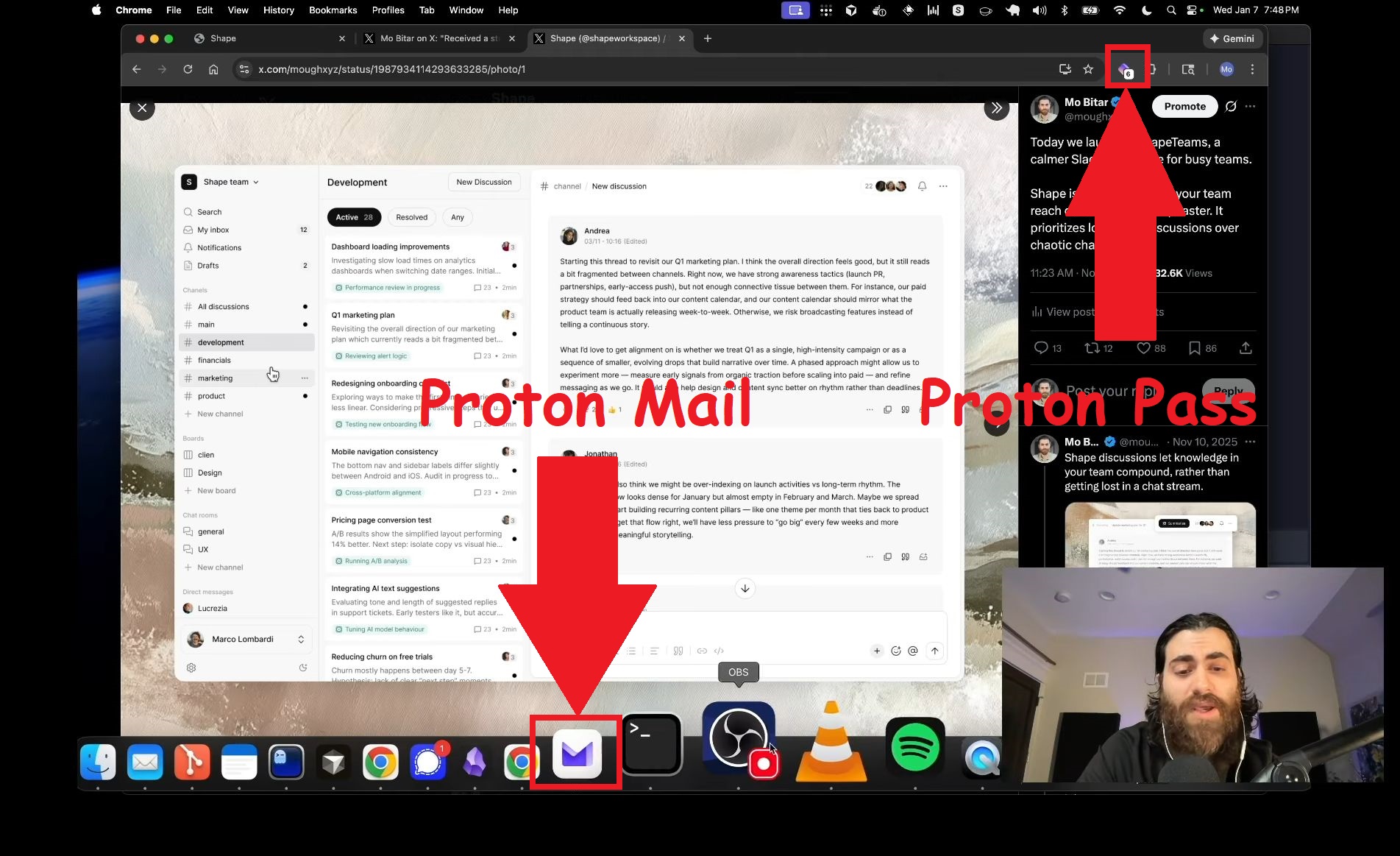
I have no clue if that’s a Gmail interface, but I watched the whole video, and @mo definitely has a Proton Mail account and also uses Proton Pass.
Yeah. Even if Proton is in the right, I am disappointed to discover that they have non-competes. I generally find them to be immoral. This definitely lowers the esteem I had for Proton. I don’t subscribe to all of Louis Rossmann’s politics, but he’s made some very enlightening videos about non-competes over the years:

I remember reading about a security guard who was out of work because his previous employee made him sign a non-compete. That is appalling to me. Even if what Proton is doing it technically legal and is not on the same scale, it reminds me of the Techtopus scandal, i.e. the wage fixing cartel established by Big Tech companies such as Apple, Google, Pixar, Adobe, eBay, Intel, Pixar, Lucasfilm, etc…The CEOs had a secret agreement that prevented them from hiring each other’s employees. Every time a top Google employee applied for a job at Apple, Apple would warn Google about them.

I can understand that it was probably a bad idea to actually publish the email, but I fail to see how this compares to the situation with Skiff. Could you elaborate on that?

To the extent that Proton may have the law on its side, I understand. But to me, discovering that they have non competes does not make Proton look good. I appreciate that it may be a standard people are used to in the US, but that doesn’t mean it’s right.

I would too. I hope @mo gets a lawyer.

5 Likes

I doubt any of us can definitely argue whether Mo or Proton are in the moral & legal right. I certainly cant. We don’t have much insight to the situation. We lack the expertise to litigate a contract dispute. We don’t have said contract

I can only say with certainty that:

  1. Proton wants Mo to delay his Shape.write product launch until 2027, and claims some legal right to enforce this
  2. I feel this will negatively impact the privacy tech landscape in some small way, by virtue of limiting competition & delaying available tools.
  3. Anything else I can say is speculation with bias

I applaud Mo for continuing to advance the privacy tech industry, and wish him the best

6 Likes

If he’s breaking an agreement made with proton it’s he that is being uncool not proton.

1 Like

Okay, that’s good, but when it’s a company that strong you should really pay attention when their lead attorney contacts you. They’ll definitely protect their business, and that’s a war you can’t win.

edit: I don’t think exposing this helped the situation. It’s not that you would’ve won without it, but now you’ve sadly burned your bridges as well. If they haven’t already do it after you left.

I tend to agree with @jonah sentiment regarding this.

4 Likes

Because presumably that was what they agreed and Mo is trying to shame proton for expecting him to honor it. Shame on him imo.

But is he really breaking an agreement here?

I don’t think anyone here actually knows the answer to this question. Standard notes is a US company so I assume the contract operates within the US legal system, but we would still need to know the jurisdiction to know whether the non compete is enforceable in the first place. If it is, we would also need to have sufficient legal knowledge to determine whether shape.work violates the non compete. I agree with others that Mo should probably get real legal help.

To me, that’s a waste of money. Legal expenses in the US are sky-high. Don’t waste your money or your valuable time—use it to work on Shape instead.

2 Likes

I am personally not one of the people who feel free software and open source software creates an “unfair” dynamic for developers.

However, in addition to the example you showed in your video I’d also point out FUTO’s take on this whole thing for you to consider: https://sourcefirst.com/, where the crux of their license comes down to:

You may use or modify the software only for non-commercial purposes such as personal use for research, experiment, and testing for the benefit of public knowledge, personal study, private entertainment, hobby projects, amateur pursuits, or religious observance, all without any anticipated commercial application.

You may distribute the software or provide it to others only if you do so free of charge for non-commercial purposes.

I don’t particularly like this license, but you might.


Some prior related discussions:

(^Why I’d agree with Mullenweg that “open source” has a well-defined meaning in the community and should never be misused)

(^Seems like a potentially cool idea, which never materialized at FUTO as far as I know)

The problem with all these non open source licenses is that people are disincentivized to ever contribute to your open source project, and people will not believe in the longevity of your project, because you could disappear any day and the terms of the license would still prevent a new competitor from taking up the mantle and continuing the work.

I think it is kind of key in the back of a lot of people’s minds simply to be able to think to themselves “well, if the Standard Notes team disappears, maybe some new team will pick up where they left off,” and Fizzy’s or FUTO’s licenses inherently eliminate that possibility.

So… a license that says “hey you can’t compete with me while I or my business are still alive” I think could be a good solution to this problem, but like Rossmann above I am not aware of any licenses which currently exist with that “deadman’s switch” type language.

2 Likes

Other people speculated this. And I would agree with this speculation too, but I said that what Shape is building is too similar to what Proton already has IMO :slight_smile:

Sentry’s “Fair Source” comes to mind, which itself seems like a variant of MariaDB’s “Business Source” (both of which I dislike, but so it goes).

Fair Source is an alternative to closed source, allowing you to safely share access to your core products. Fair Source Software (FSS):

  1. is publicly available to read;
  2. allows use, modification, and redistribution with minimal restrictions to protect the producer’s business model; and
  3. undergoes delayed Open Source publication (DOSP).

The thing is, this situation was made public. And, folks have arm-chair opinions on whatever is public. And if those opinions are wrong, then whosoever wants to correct the record will have to make more things public. But hey… “rage bait marketing” (mirror) is all the rage, so :person_shrugging:

6 Likes

I can’t fully grasp what such licenses really accomplish. Sure, I can’t legally directly take your project’s code and start selling it. I could instead have an LLM quickly scan your code to recreate a derivative of your work without it being exactly your work.

Of course this alone wouldn’t let me quickly recreate something like FUTO as by far the most complicated tech there that they’re not (easily without extracting it from their .apk) publicly exposing is their ML model (that I was literally just writing about What keyboard are you using on android? - #46 by lone-cloud ) that’s used for auto-correcting. I think it would be immensely hard to fine tune a super well functioning model like that and you still couldn’t compete with the big boys like Google’s GBoard.

1 Like

That is protected by copyright.

I mean, if you aren’t in a position to enforce your copyright license then sure you probably shouldn’t publish your source code at all, but that’s the unfortunate reality of the legal system.

1 Like

I don’t believe this is a cut and dried case and is more of a “it depends” grey legal area in the modern world. Having AI rewrite an existing app without directly copying any code can be seen as a new invention. They can’t copyright their ideas nor algorithms, but the implementation is copyrighted.

Source: Copyright for algorithms - Ethical, legal and environmental impacts of digital technology - AQA - GCSE Computer Science Revision - AQA - BBC Bitesize

Algorithms present difficulty and uncertainty in the law since they do not fit nicely into copyright or patents.

Copyright covering algorithms can only be applied once the programmer converts the algorithm into source code. The copyright of the source code can be used to protect that code from being copied, but will not prevent others from independently creating their own source code which does the same thing.

claiming they have a monopoly on encrypted tools.

Er, no? They are claiming you (Mo) specifically are violating an agreement you signed with them voluntarily.

I like Proton but this is not cool.

If you want to talk about what’s “not cool”, it’s pretty lame to sign an agreement in exchange for compensation and then complain when you are actually held to its terms while pretending Proton is saying something they quite clearly aren’t.

It’s actually shockingly dishonest to me to frame the email they sent as Proton claiming they have a broad monopoly on encrypted tools. I feel like Mo may as well have just said the sky is green.

I mean, that could be quite wealthy if you were maxing out your 401k with a full match and it was specifically the last 10 years in particular. And it’s not a retirement account, it is freely available to you to invest or use however you want right now. Also, it doesn’t matter. You agreed to not compete with them in exchange for that. If that wasn’t worth it to you, you shouldn’t have agreed to it.

I don’t see why that’s relevant.

That’s not the question though, the question is does your E2EE tool compete with Proton’s? Is it a market replacement for any of Proton’s products? It seems like it is.

You didn’t have to agree to the terms they offered you. Sorry that you did without fully considering the implications, maybe instead of trying to publicly shame them for exercising their rights under the agreement you signed you should take it as a lesson to be more thoughtful about your business dealings in the future.

Why is he tweeting that Proton thinks they have a monopoly on encrypted tools and simultaneously saying in a video he thinks it’s just a misunderstanding? These two things are not compatible. If it was a misunderstanding, and that’s what he thinks it is, trying to publicly shame them like this is wildly inappropriate.

This is clearly an attempt to pressure them to not enforce the noncompete by making it more costly for them PR wise than it would be to just let it go.

4 Likes

I feel like this entire thread is going to give ideas to Proton’s legal team or Mo’s lawyer(s) should this escalate.

We’re at this point simply debating on what’s right or wrong, morally and legally, which is not going to do anything. I don’t know what Mo is planning on doing but I hope he rides it out for another year. You have a lot of years left Mo - I’m sure there are many great tools you’ll build and monetize. Fighting this is not going to look good for either party.

1 Like

In my professional capacity, I am perpetually engaged with inter-company IP/NDA agreements, and if the contract Mo entered into is even a tenth as robust as I genuinely presume it to be—given we are discussing an enterprise of Proton’s magnitude—his prospects of advancing the matter through any means other than squandering his financial resources are precisely zero percent.

edit. Just to clarify: I’m an engineer, not a lawyer.

1 Like

For all those people feeling appalled by the existence of the non-compete. Imagine Proton buying SN and right after that Mo going, taking the open source code of SN and spinning it up as a new project drawing in all the people that were not happy with the acquisition (or just liked SN and wanted to support the OG). I mean Proton would have to be stupid to not cover this - so a non-compete had to exist. And yes, anyone still could have done this, but Mo was in a unique position of knowing exactly what to do and having the benefit of the users that already knew him.
Whether it is applicable to the Shape.work or not is a different question. But clearly SOME non-compete had to exist.

4 Likes