Recommending Frigate, a "Privacy Focused" and Local NVR Open Source Platform to Build Your Own Security Cameras

Website

Short description

This is a NVR Open source localized platform that allows you with the recommended hardware to set up your own AI assisted security cameras for your home. All processing is performed locally on your own hardware, and your camera feeds never leave your home.

Why I think this tool should be added

I think it should be added because when we talk about control pyramid the bottom of everything in Tech is hardware and the more we can get people off of ring and similar cameras the better. I also think building a project like this is something more people would be interested than we think and can also aid in learning about other Tech aspects that’s upscaling them to more complicated systems.

Section on Privacy Guides

Hardware

2 Likes

I am interested knowing if this is a good (or good enough) solution for NVRs as I plan to deploy CCTVs and NVRs.

All I know right now is that Frigate can be self-hosted as a TrueNAS Scale App and IIRC can also be used in coordination with Home Assistant (and maybe with ESP32Home as well).

Another alternative I have heard of is Synology Surveillance Station but I have not even checked if they are open source or at least meets with our basic privacy requirements. One disadvantage of SSS is that IIRC they have a per CCTV license requirement.

Anyway, does anyone else have experience with this?

I’ve only read a bunch about frigate as I’m running a home assistant. It’s supposed to have a great integration there.

It’s not that easy to get into as you need to buy that Google TPU which is usually overpriced and was hard to find for a while. Even after you get it, you’ll have to pay for a trained model to run on top of frigate which is the main piece that can help decipher that ex. a squirrel is a squirrel and not a dog based on other people’s training via machine learning.

1 Like

yes. been using it for years and I’ve recommended it quite a bit, here and irl.
I have some small issues due to my cursed setup of container in vm and having to pass through everything and my patched qemu but that is my fault.

while I use a coral myself, they aren’t recommended anymore and instead now recommend offloading to gpu afaik

this is completely 1000% optional

this is false. object detection and identification works 100% without paying a subscription.
those paid models are optional for custom objects and additional tuning.
and the current beta actually supports custom training for free without their paid cloud service: Object Classification | Frigate

4 Likes

I also saw this Hailo-8 AI accelerator but it is only supported in a AArch64 system (Raspberry PIs) and AFAIK it does not have support for x86-64 system.

GPU seems nice and I already have this Sparkle A310 ECO in my TrueNAS so I guess I could utilize this. What is wonderful about this card is that I runs completely on PCIe power and does not need an extra power cable. I wish I had a more powerful compute but that means more power consumption as well.

Those newer Intel B50 and B60 seems to have more AI compute but I do not know if it will work in a low profile-ish 3U single PCIe slot .

1 Like

These are good corrections to what I wrote. As mentioned, I never used frigate, but occasionally hear about it as I’m running HA.

I confirm that this is what they have in their docs now too. The coral seemed great to me due to its relatively low (compared to other options listed) price and small form factor. Offloading to a GPU sounds insane to me. I see that they recommend CUDA or ROCm discrete GPUs which are way too expensive to justify buying for something so niche. AFAIK, you’ll need a semi-modern GPU to support those drivers, so it’ll cost at least ~$400.

My problem with frigate is that it’s far too niche and costly to seriously recommend to someone. As I see it you need to:

  • have a large enough property to justify setting it up
  • be tech-savvy
  • care about privacy
  • willing to spend ~$1k on PoE cameras, NVR/server, detector/GPU, maybe Frigate+ subscription
  • have the free time and drive to set it all up as a custom system
  • continue maintaining and training your model for best results

To me this is all way too niche, time consuming and cost restrictive to justify trying it out. I currently have some shitty wifi eufy cameras that strictly point outside, have their own NVR and motion detection, but they work well enough with my home assistant automations and can alert me via UnifiedPush. I’m sure they suck for privacy, but it’s very hard to justify switching to a frigate setup.

1 Like

I understand all your concerns and I even agree what most of them, but I do want to offer these counterpoints.

One is that some of the points that you make could easily be argued for a lot of the recommendations and guides that we have here on Privacy Guides. Like we try to make it as easy as we can, but there’s just certain topics where you need to have a certain level of tech literacy in order to make them work such as flashing over Graphite OS or many of the self-hosting stuff. I think this is why we have guides for them to try to make the process as simple as possible. Otherwise we, in my opinion be ruling out many of our recommendations.

In fact, I would argue that similar to someone who wants to replace Windows/Mac/Mobile OS r to do self-hosting that the person who would be interested in this topic would already be either tech savvy enough or willing to learn in order to achieve what they want.

Second of all, here are a GitHub text guide as well as a video guide on the topic that I think would be useful for informing people on how to set things up:

My only negative about this guide which is more of a negative or going to have to face in general is look at the original prices when the guides were written and now look up the same stuff now. To be fair, some of the stuff if you go directly to the online store of the product it’s slightly cheaper. But yeah, the whole tariffs and RAM situation is killing hardware. And this is not unique to NRV this will also impact things such as suggesting pixel phones or Graphine OS as well as other hardware requirements for other guides and recommendations.

In Short Raspberry Pi needs to change their “For $45 slogan” once the AI + Tariffs stupidity is more like around $100 now.

2 Likes

As I set up my new home this year Frigate did not meet my requirements personally, so I do not have much experience with it. But I can tell you Synology Surveillance Station is a poor choice. It does not work reliably enough in my experience and the per-camera licensing pricing is straight-up insane for what you get.

Maybe if someone asks me what my camera setup is in another thread I’ll share more, but I don’t want to derail this Frigate discussion further :innocent:

Personally I don’t believe it’s possible to spend much less than $700 on a 4-camera system without making major compromises (~$200 NVR, ~$100/camera, ~$100 HDD).

If you have a reasonable budget like $700 in the first place, I don’t see why Frigate couldn’t probably fit within that number. If you don’t even want to spend that much… maybe you’d need to investigate https://thingino.com/

2 Likes

Just like plenty of other topics here, this is very cool but more of a self-hosted thing. There is no plug & play solution that a newcomer would be able to achieve if you mention things like “Docker” to them.
So it is amazing for the self-hosting community but doesn’t really check the box of usability. :sweat_smile:

Very much one of the best available solution as of right now from my research. :+1:t2:
Especially if you already have some NAS + Home Assistant setup yes.
YMMV when it comes down to performance / quality / gear with your hardware but it’s definitely privacy-respectful and flexible enough.

Not sure if your need is for personal or business use, but I wouldn’t take this path for either because you’re putting very sensitive data in the hands of somebody else. Highly not recommended. :cross_mark:
At the same time, if you want to have some business support in a work place where somebody would take the maintenance/issue resolutions in hand, then maybe? :thinking:

You can also get plenty of other alternatives that might be cheaper/more powerful depending on your needs. Overall, not everybody needs to have a quick inference + precise knowledge of what kind of Dobberman is in your living room, just knowing there is human/animal movement in a giving area is plenty enough (especially if you film outdoors and make masks). Their docs are quite good on that regard. :+1:t2:

I am sooooo happy that Intel is proposing such an amazing value GPU, a new Arc B770 is rumored to join the other Battlemages! :man_mage:t2:
I really hope Intel will continue their new Arc because they are the most healthy alternative to AMD/Nvidia at a super cool price for now! :star_struck:
But nothing is less certain given how bad the situation is at Intel…and given that is kinda controlled by Nvidia now. :unamused_face:

But yes, having such a GPU is a very cool alternative to Coral-like accelerators especially if you have a cool NAS setup already. :drooling_face::100:

I guess it depends on how much cameras/their resolution/other details. It might be cheaper to have a beefy central processing unit that does all the heavy lifting rather than offload it to each camera/clusters.
But it is indeed quite crazy to think that you use the same thing for your fancy Cyberpunk 2077 in 4k@60 as for your living room’s CCTV. :joy:

Indeed, it’s not a quick and simple product that works out of the box and is privacy respectful. Moreover, it is a very niche product given that it is for a personal use at home.

Business would just pay a company with their proprietary Windows-enabled tool and not care about privacy. Simple regular users will just buy a cheap 20$ cam on Amazon and install some shady app without thinking twice about what they’re signing for just because they saw a landing page with the famous "it's secure" + SVG icon of a lock combo.

There are definitely quite a few requirements to achieve a private + secure DIY NVR setup.

Yes, getting there is quite a journey for sure. :melting_face:
Not sure when I’ll be able to reach it myself but it takes a lot of time/effort/money to do right.

Haha yeah, either use an evil tool/hardware or don’t implement anything are the 2 extremes.
The “do it right” in the middle of those is quite hard to achieve.

Flashing GOS is nothing to compare to a NAS setup + Docker knowledge + networking isolation + hardware tweaking + everything in between.
One is a “press the button in chrome then on the phone”, the other is the result of several entire domains of knowledge. :grinning_face_with_smiling_eyes:

Self-hosting is definitely picking up more and more in this community and it is amazing!
Not everybody is about privacy so bringing it to regular self-hosting communities is also a hard thing because not every enthusiast cares about privacy.
And even if somebody here posts a guide on how to set it up, it will be one way of doing things and if there is the slightest in your setup, then it will not behave as you expect it to be. There is hence a need of either:

  • 20 ways of achieving the end goal
  • a progressive walkthrough of all the different domains stitched together
  • a livestream so that the audience could interact with the host (allowing for a more accessible guide)

The guide from Chuck that you posted is a good example of several issues:

  • the written guide can be above the head of a lot of people already, because it assumes that you know how to navigate your way alongside Docker etc
  • he also shows a few ways to achieve it but it might not be the way you want it, a video/written tutorial is not always the most interactive
  • the prices might change yes but that’s not even a concern at this point if people are based elsewhere (me in EU, the stuff linked is either overpriced or just not available)
    • that is meanwhile not a problem in itself, people should be able to source the components if they are easy to search for with a specific reference
  • I haven’t watched this video specifically so can’t comment any further but there are overall quite a few other respectable channels that shared ways to achieve a working NVR setup :+1:t2:

Overall, there is a bad news: PG will not be able to hire a fulltime self-host guide writer anytime soon I think.
Good news: there is definitely plenty of demand on that topic on the forum + I feel like more and more developers are joining the forum as of recently, hence more content via different mediums will probably pop up from the community this year. :+1:t2:

I’d say that NVR is still niche, topics like OpenWRT, Ente Photos or alike are still far more asked + needed + generic (I include myself in that lot :grinning_face_with_smiling_eyes:) but the time will come for NVR too dw. Also, you look quite savvy enough yourself to buy the hardware + figure the software part. :flexed_biceps:t2:

The tariffs/RAM/etc is just a temporary thing and some people would be fine paying the premium. Otherwise, they can always use what they do already have, it is beyond the guide/teaching part anyway. :white_check_mark:
Privacy will always have quite some friction to it anyway (unfortunately). :unamused_face:

I wonder where such thing needs to be asked. :winking_face_with_tongue:

Agreed, this should be an overall starting point budget.
You could get lower if you buy some camera modules, print your own cases and have an already running homelab with PoE switches etc…but that is stuff that you bought before at some point so not really an “NVR starter kit” haha.


Currently it’s either:

  • DIY bro, get a 3D printer + become a network expert + get some coding skills, and roll up your sleeves kind of situation
  • subscribe to our evil-we-dont-give-a-crap tier with our vibe-coded-reinvent-the-wheel mobile app that will charge you plenty without even doing E2EE because why would it? :woman_shrugging:t2:

Something in the middle, that is respectful of the end users, plug and play, not owned by Big Tech, with no subscription and that is based on open standards still has an open slot.
But the amount of work + knowledge required is quite…abysmal.
And it’s hard to fill the gap from DIY → accessible normie product with a decent price.

4 Likes

My arguments still stands that we have more complicated privacy setups in the guides that would be really inaccessible to newcomers that we specifically highlight as advanced topics with computer knowledge and or hardware knowledge needed.

I would put this under that category in my understanding if we have suggestions on how to set up your own email server which even season administrative personnel find incredibly frustrating to do and we also have self-hosting recommendations like nexcloud. We should be able to include this as an alternative hardware surveillance option.

And I think that despite the difficulty, it’s really important to put such options there. Because if our perimeter is, we only do plug and Play. Not only are we going to get rid of a bunch of more advanced privacy options and features, but people are then going to go to the defaults and the defaults are the ones who are selling your data and your privacy such as the ring cameras. .

In addition, I believe that if such a topic is highlighted in featured, it would encourage the development of the eventual plug-in play. Remember that initially vpns and the toronian Network was seen as a very Network knowledgeable having to use terminal responsibility and due to its promotion and development. The torfoundation eventually made a plug and Play browser version that everybody uses.

Basically, I don’t want privacy guides to lose the forest for the trees. We should be nurturing projects like this and push for them eventually making more simplified versions instead of throwing the baby out with bath water. When you do that, this is how. For example, the Linux Community lost support initially and people kept defaulting the windows. It wasn’t until internally. People started pushing complex projects and then rallying for them to be simplified that we have the much more user-friendly Linux ecosystem that we have today.

My response to this is particularly what we are targeting are systems like the ring cameras. And the thing about those cameras is we need to actually look at the user data of what people are using the use case for. And the thing about ring is they’re not making most of their sales by doing four plus cameras on a suburban home. Their main product and what they make. Money and sales hand over fist on is people simply installing one camera that doubles as a doorbell on their front door. I live in a city tenant apartment building where those type of cameras are literally in front of every single home despite it being a project. Having only one camera significantly reduces the price of this entire thing and that’s why I included the original GitHub that someone made of how to hardware put this together, even though that hasn’t been adjusted to the price inflation of hardware months later. Thanks to tariffs and AI eating up all the ram.

I just want to make sure that we’re arguing for the actual use case of these things instead of a theoretical how people are possibly using them in the most secure fashion available, which to be fair if we applied that to other privacy stuff we’d recommend would also hugely increase the hardwareing software costs.

Once again, everything’s about threat modeling. Most people aren’t doing a 4 plus camera setup for their home. They’re doing one camera on their front door. Let’s focus on that.

Past a specific amount of technical requirements, there is no point doing a guide from A to Z. If your goal is to achieve 100ms gain on a specific lap of an F1 race during your daily trainings, what’s the point of giving you driving lessons like it’s your first time in a car and explaining how the pedals work?

Some skills are additive and assume some prior knowledge to even get started.
Other can be done from scratch because the amount of knowledge/work is low enough to be acquired in a small amount of time.

Not everything is easy to achieve. Simple example is Louis’ wiki on how to get with self-hosting: it is very opinionated, very dense and quite specific.
Imagine having a different router, different config version or having some weird CLI issue. Good luck trying to figure it out by yourself if you have no clue of what you’re doing in the first place. :sweat_smile:
If you have the exact same setup, goals and everything aligns perfectly, then cool yes! But for how long? Such guide also needs maintenance. :skull:

A software solution with pre-baked tools + sane defaults is very different from a combo of:

  • hardware to buy given the local store availability + networking constraints etc etc
  • your personal space/needs, that might be very different
  • software: that one is comparatively easy if you have all the rest

Yes. Planning to do exactly that.
Takes time, effort, dedication to get there, not as simple as throwing a wall of text.

I mean, resources are already available out there if you look for it and have the skills, but there is definitely an educational gap that could be filled. Finding the right approach + tone to educate people is probably the hard part here.

So…you expect:

  1. personally-owned devices and FOSS app on your phone (not owned by any potentially malicious company)
  2. that do monitor and backup some footage 24/7
  3. with automatic and good quality, compression, storage
  4. decent video feed, not a cheap 720p@5FPS
  5. with no vendor lock-in of any sort
  6. sustainable company that is able to sustain itself in the long term
  7. with no subscription/not too expensive one-time purchase in comparison to the competition

all of this…to be plug&play? :thinking:

There are efforts to move the whole industry forward with standards and tools over the years.
Issue is: this stuff takes ages for a simple reason → there is usually no money behind those initiatives. Hence nobody is in a rush to push them forward, they’re made on people’s spare time or with delicate fragile decisions that need to have everybody on board so that 1 common goal can be achieved without having too much bias/drawbacks.

Example of this can be stuff in the Web industry or even just Matter from the Home automation community, those standards take years usually because everybody needs to agree on them.

It is just so much easier to spin up some random wrapper, require people to create an account on a server, have some custom-made let’s-reinvent-the-wheel awful software and sell it to people with lots of marketing, play on their fears, pump some money and just lock it down some day when willing to juice users more and more.
It is easy, simple and makes money. Hence why we have 400 companies with names that nobody cares, knowns and will ever see besides maybe in a security leak news headline.

I am not sure how sustainable (and good/bad) the Tor Project is but after a quick look at the Wikipedia page, I wouldn’t call it a “huge success” given the 20 years of existence.
Yes it is still live, yes donations keep it afloat but there are quite some politics + companies backing it up too.

It is also quite laughable the amount of money they made in comparison to any kind of tech company. I’d say that same goes for Wikimedia/Wayback machine/plenty of other FOSS tools btw, they are afloat but not by a long shot.
Again, it is also being non/for profit kind of situation but we go back to the standard/crappy startup diverging paths again. I am definitely no expert on how sustainable this model is but plug&play NVR is not a solved problem as of today (and won’t be for a long time IMO).

Good idea in theory.
In practice, some topics are just intrinsically hard to achieve in a simple manner while keeping all the fancy features.

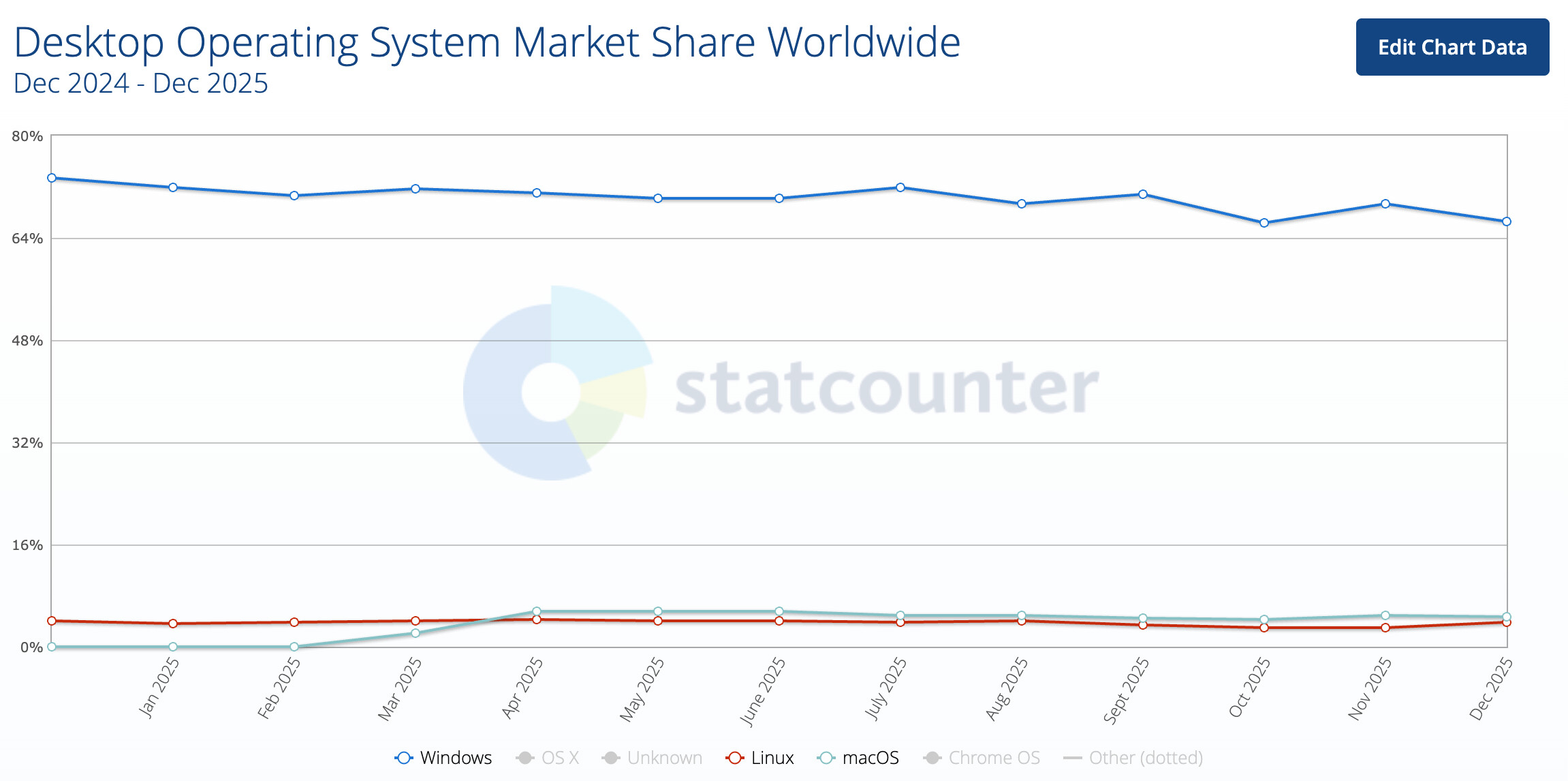
Why using a past sentence here? Linux is still far behind MacOS/Windows, don’t fool yourself.

  • 4.13% in December 2024
  • 3.86% in December 2025

Linux usage is stable at best. More noise around it for sure, yet your normie friend is definitely not hand-rolling his Arch install anytime soon while willing to play with his friends on League.

PS: there is meanwhile a rise in the unknown OS, might be some Linux distro that is not well detected?
Maybe it’s SteamOS or BSD? Not sure but might just be noise/something else.
Anyway, I’d be happy if Linux conquers the world too, don’t get me wrong! :smiling_face_with_three_hearts:

Not sure about which projects are recently pushed on Linux more than ever.
Linux always slowly improved because people find ways to improve the UX but again, those improvements see the light only because there is Canonical, Steam, Redhat or some other successful company achieving sustainability behind the curtains.

It is not achieved through sheer will from 5 random individuals in a dorm room in a small village with no funds.
Understanding that money is what pays the bills and moves a project forward is important. Because burnout and bankruptcy is a real concern for any kind-hearted solo individual willing to leave something positive to society. :broken_heart:

Also, sorry to say but Linux is also a ginormous mess of people having very different opinions on how things should be done. Just like open source software in general.
Hence why we have millions of distros and tools doing kinda the same thing at the end of the day.

2 Likes

Want to ring at every person’s place and recommend them to follow the GH link to DIY their camera?
Let us know the success rate of that one. :speak_no_evil_monkey:

Tell us in 2 lines how can you achieve a secure doorbell camera with all the cool features and none of the drawbacks in a realistic way. I mean, the cameras used today are not anyhow safe to begin with. :joy:

But yeah, you could probably stick some button battery to a camera sensor and broadcast the entire thing to some wifi nearby? Achieves some of the features, yet still miles away from a proper implementation. What’s the point of having a 2nd solution that is DIY and just as bad/cheap? None really.

I mean, if you do want to have an NVR setup, you might end up just like Chuck in the video and have 10+ to properly fully cover your space. It is not trivial and you need to think about it ahead of time to accommodate for all the requirements.

You yourself started a topic + linked resources that are all but “how to achieve a doorbell camera” as far as we can see. Frigate is also probably not the right tool for such job. :slightly_smiling_face:

1 Like

This proposal is not a viable solution for that type of user though, which is why I am focused on the people who want a dedicated NVR like Frigate.