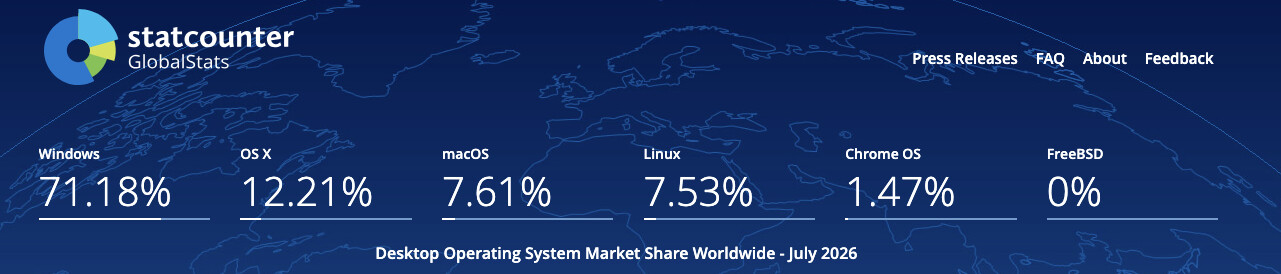
As per 216593 – [macOS] Limit reported macOS release to 10.15 series Safari user agent is still reporting OS X 10_15_x for much newer systems. You’ll probably get pretty close if you count Mac OS and OSX together.
Usage share of operating systems - Wikipedia reports Mac OS market share at 14.58% as of June 2026, but things are in motion with Windows sucking more and more and Mac is bound to be lower barrier into UNIX-like world for average Janes and Joes.
Also Linux probably spikes a bit this summer with e.g. LTTs extended coverage of Linux for gaming and daily driving.
It was around 5% when I checked a week ago.
Wait. Does default browser header state your OS? Or is this discovered by fingerprinting your device?
They should be 100% transparent about this…
By default yes. You can (but shouldn’t) spoof it to anything you want trivially with e.g.
The thing is that unless you know exactly what you’re doing, it’s possible you’re just falling into the even smaller group of users in the bucket of “Obviously runs Linux Mint but also likes to spoof the user agent to Windows” or whatever.
It’s a much better idea to user Mullvad or Tor Browser to have your browser to look like the Tor Project Base-browser (that apparently is the parent of the two products). That way you let experts build the fingerprint-resistance, and you fall into one of the three security level buckets the browser offers.
Why would you be interested in the market share percentage ? I mean we use Linux because we love it, isn’t it ??
More Linux desktop users means companies can’t as easily ignore Linux users. For example, better hardware and software support. There is also higher potential for more user donations to open source projects.
Though, more users are also means more problems. Security through obscurity becomes harder to justify. For example, the AUR has been infested recently with malware.
Linux, with its love for free and open source licenses that allow quick forks, is difficult (not impossible) to control. Due to lack of users, many companies and governments don’t even bother trying to control Linux users since the effort isn’t worth it. For example, the US carved out an age verification exception for Linux and other open source OS’s. The thought process probably entailed that its mostly professionals and nerds using Linux anyway, not kids. Similarly, Brave gave out Brave Origin for free on Linux. Brave explicitly said they did it because they expected the Linux community to fork it if they didn’t (some desktops that ship Brave apparently already had created a Brave Origin like experience according to Brave). Considering the small percentage of Linux users, it’s easier to just focus on making money on other platforms and let Linux users be the loud tech spokespersons for their friends, family, and colleagues on other platforms.
We will see an increase in security incidents for sure.
Very true. I think the higher prevalence of security threats will also force a bigger discussion on the current desktop Linux landscape.
We’re not just seeing more Linux users, which means more incentive to target Linux, but this is also happening during the AI revolution where creating malware is both easier and more accessible.
As the platform grows developers will put more resources into supporting / maintaining Linux software.
Yeah probably not much, people who use Linux are far more likely to block trackers they use to gain that data…
Thanks, Cloudflare.
I hope you’re right, but I’m afraid you aren’t.
Linux gaining (a little bit) of traction over the last decade made so many new distributions come out. It’s like fast fashion, like every user wants to express who they are through their distinct OS.
Alas, maintaining seriously a distribution in terms of security is a very hard and tedious job. Arch decided not to do it and openly leaves it to the users. RedHat/Fedora and SuSE have big resources and do it seriously, Debian does it somewhat and Ubuntu so-so.
But all the derivative are often from a small group of friends’ initiative or from small structures who cannot pay full-time security engineers to check every package update, to update SELinux profiles and run the tests… So derivatives are, at best, as secure as their parent distro, and usually worse.
So it seems more users entails more scattering, which entails less security in general.
Linux literally means that I can create my own distro, correct ??
Yes, if you have a lot of skills, time and friends with skills and time ^^
If you want a better idea of the actual Linux market share try looking at the monthly steam hardware survey.
That would only cover PCs of (part-) gamers, no?
It would not account for exclusively professional systems like internal office PCs, which I assume would be a noticeable share.
I guess the most reliable source would be probably Google Search, assuming the vast majority probably does not alter their UA string, wouldn’t it?
Steam survey is self reported so it’s less vulnerable to inflation from bots. I don’t think Linux has that large of a desktop market share in workplaces. Most of the people I’ve spoken to that work in IT have said that windows is easier to setup, support, and manage in an enterprise environment along with most users already being somewhat familiar with it.
Right, but that doesn’t change the outcome, does it?
I mean, instead of reporting Linux, they report as Windows, so it indirectly reduces the Linux share.
And even if we’re considering an influx of bots on websites or even Google Search, I’m sure Google would be very capable to get close to actual user numbers and differentiate the vast majority of bot traffic.
They lack any incentive to report, though, as well as big data brokers would.
But it’s the broadest dataset I can imagine.