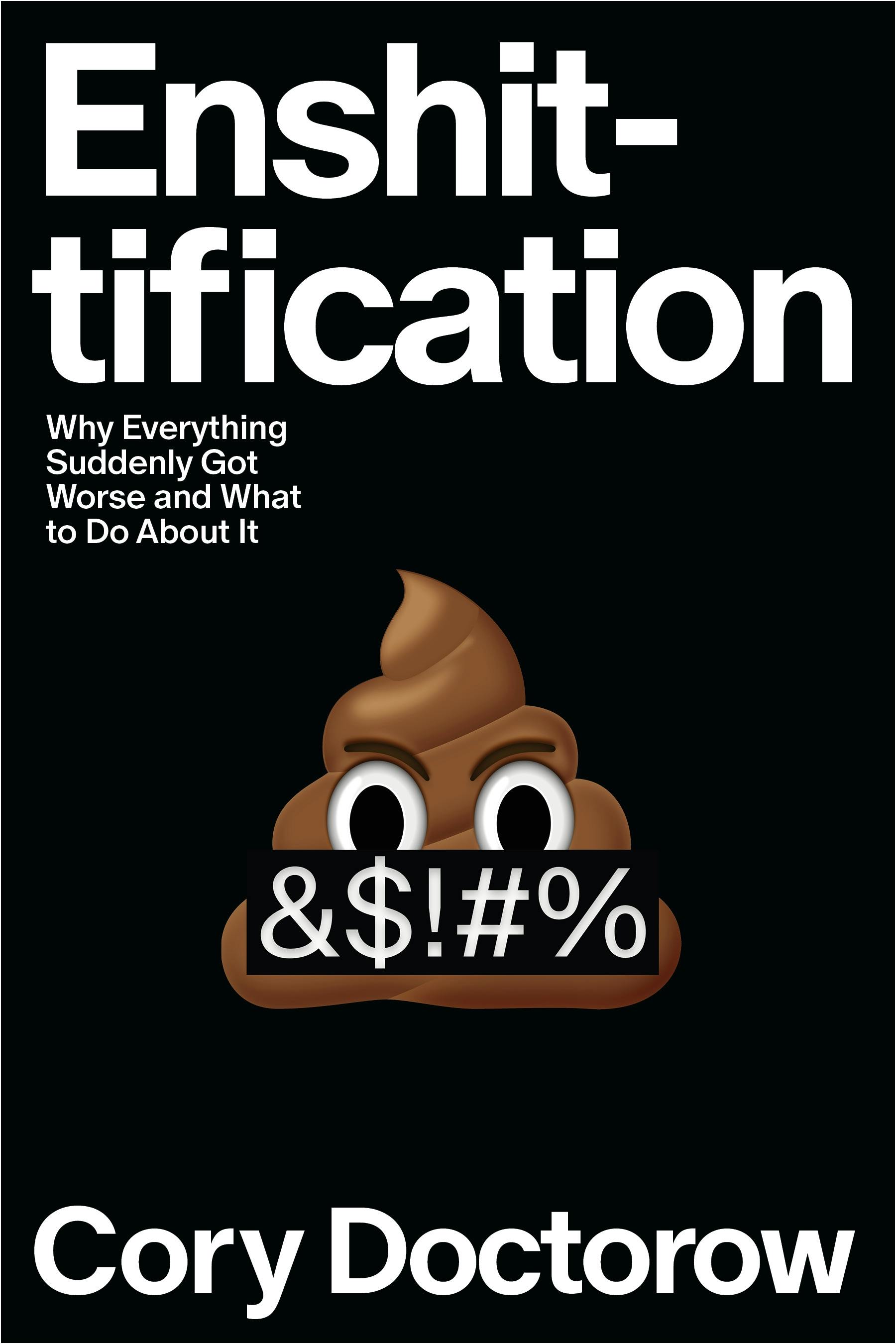
Cory Doctorow's Enshittification book is out today!

Cory Doctorow, the writer, journalist, and activist who coined and popularized the term “enshittification” to decribe the decay of platforms, just released his book on the topic. The full title is: Enshittification: Why Everything Suddenly Got Worse and What to Do About It.

I just got my copy, and I’m so excited to read it!

Blurb:

The once-glorious internet was colonized by platforms that made all-but-magical promises to their users—and, at least initially, seemed to deliver on them. But once users were locked in, the platforms turned on them to make their business customers happy. Then the platforms turned to abusing their business customers to claw back all the value for themselves. In the end, the platforms die.

[…] in Enshittification […], Doctorow moves the conversation beyond the overwhelming sense of our inevitably enshittified fate. He shows us the specific decisions that led us here, who made them, and—most important—how they can be undone.

Privacy is a human right. It is also a consumer right. And many other consumer rights intersect with privacy, like the right to own the data that you generate, but also the right to own the physical (devices, cars, printers, etc..) and digital (e-Books, movies, TV shows, software, etc..) things that you buy.

If you care about these privacy and tech related issues, and want to understand them better, and learn the ways we can fight the abuse of corporations, I highly recommend you give Doctorow’s book a read.
6 Likes

Oh thanks for the reminder! I was just wondering about this yesterday.

1 Like

Would be curious to hear his arguments but I guess the main driver will be: capitalism. They somehow have to make profits (or, show enough growth for investors to keep investing).

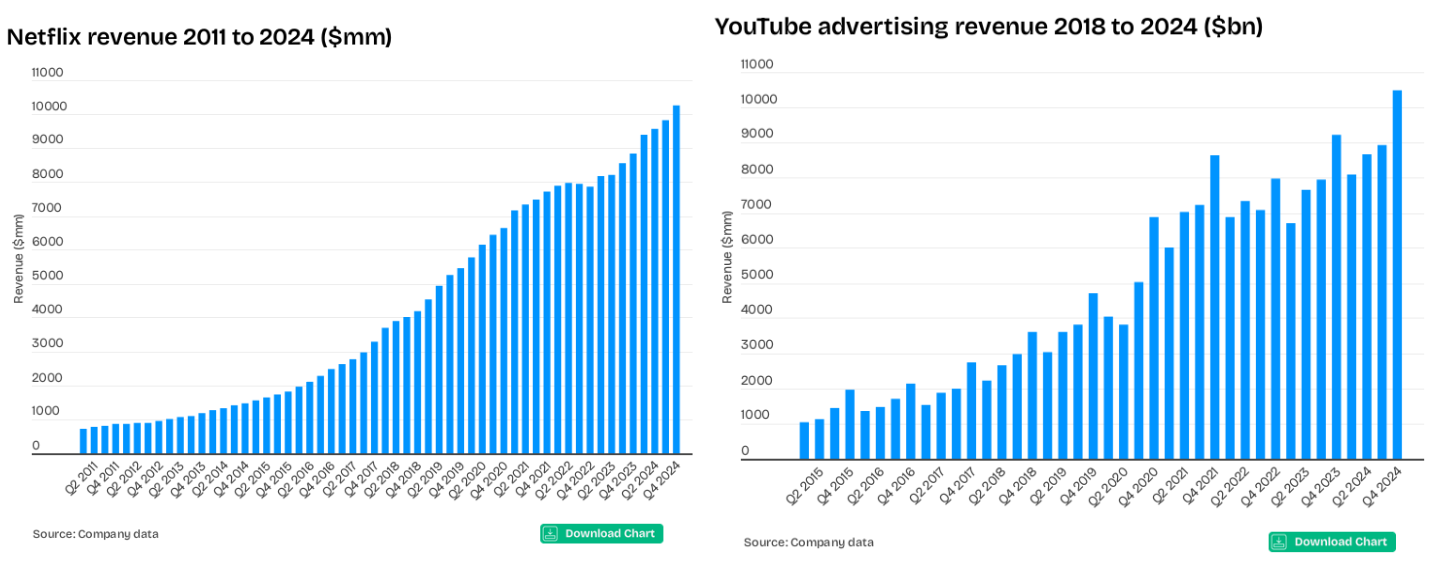
Just looking at the revenues of Netflix and Youtube, you can clearly see that the exponential growth - which is needed to satisfy investors with X% of revenue increase per year - decreased:

Sources: Netflix, Youtube

The services have to run on something, either the promise to be profitable in the future (by increasing user size and then, turning it into paid memberships) or being paid only from the beginning.

1 Like

Late stage and extremist capitalism*

Mismanagement and greater expectations every quarter is leading to bad business decisions where billions are now being wasted on AI today while they are aware they are in a bubble. There’s no logic to it. These people are children with money in adult bodies that are clinically sane - nothing you can do about it.

1 Like

just picked up the audiobook, excited to listen.

1 Like
1 Like

Thanks for this!

Here’s another one where Cory discusses enshittifacation and its implications with regard to privacy with former FTC chair and consumer rights champion Lina Kahn.

It’s also available in audio form from Cory’s podcast:

1 Like

Thanks!

I see your Lina Khan and raise you Democracy Now! interviews

Part 1:

Part 2:

1 Like

Yes, I saw YouTube suggest me the Democracy Now videos too. I love Democracy Now’s work. I wish they were more popular. Looking forward to chewing through all this content. I started the book, and so far it’s very compelling! I’m enjoying it!

1 Like

I’ve been listening to this interview, and it’s fascinating to realize that one of the major reasons enshittification is able to happen is because there is little privacy protections. If we had banned the monetizing and exploitation of data before social media, enshittification would be much harder for many companies.

But that would be anti capitalistic and therefore un-American - as the argument will go. And it would impose on the freedoms of individuals and corporations alike to not be able to do what they want especially economically for commerce. And that’s beyond the pale for today’s America.

I don’t think this problem can be solved with legislation but a massive cultural shift, if at all this is even feasible to think about. Grifters will always grift. People will always push for the limits for what can be done and what’s possible. It’s cancerous in this way or somewhat even inherently.

For a second, I thought you were being sarcastic, but apparently not. Have you started the book? Something that Cory has mentioned many times in his talks and published articles, and long before his book was published, is that the last time America passed a federal privacy law was in the late 80s. It banned video renting stores from sharing the personal information of its customers. They did that because the renting habits of a politician were apparently exposed.

My point is, if it was possible and righteous to pass a federal privacy law back then, it’s possible and righteous to do it now. It’s just so much harder at present. But some states, especially California, have much stronger privacy laws than others. So it is possible.

I disagree that it imposes on the freedom of individuals and corporations. The data that we generate should belong to us, because we are the ones generating it. Not the companies whose services we use. Privacy should be the default.

If I follow your logic that it imposes on individual freedom, companies that offer privacy as an option but not the default could say the same thing to justify why they don’t make privacy the default, pretending they care about the freedom of their customers, when all they really care about is their bottom line.

I partially disagree. Yes, a cultural shift is important and necessary, but so is changing the law. It was Carissa Véliz who planted the idea in my head that we should ban the monetization and exploitation of personal data through her book Privacy is Power. I agree with her and strongly recommend you her books. It makes perfect sense to me. Even though it is hard to achieve, we should absolutely aim for that.

I can’t remember exactly how he said it, but in one of his recent videos, consumer rights activist Louis Rossmann said that we needed to change people’s minds before we change the law, because it’s much harder to change the law without having many people on board. This is where I join you on the cultural shift. But the cultural shit alone is not enough. We need to change the law.

Corporations and governments are powerful enough to defy the will of the people. One of the ways they do that is by nudging you into it. They also do their best to shut down critics, which is why we must be loud and many.

1 Like

Got my (signed) copy through Cory’s KickStarter campaign! Can’t wait to read it! I’ll be starting it soon - like maybe today.

Watching this right now…

2 Likes

I was actually being sarcastic but also playing the devil’s advocate a bit.

It wasn’t the righteous or righteousness that passed the law, but one politician who didn’t want others to know what they rented from Blockbuster. But I take your point.

Not really. Then I guess what I meant earlier was that there is no political will I see any meaningful privacy law be introduced and passed in the US today.

I agree. But that is not the law says today nor what the understanding of this is in the hyper capitalistic America today.

Yes. But no nation state will make this happen. I agree with you in principle obviously.

Let me make a slight amendment to what I said then -

“I don’t think this problem can only be solved…”

Yes, yes - I know. This is what brings me back to there not being any political wills because the politicians are working for lobbyists and not necessarily their constituents.

Given the rate at which they are trying to make privacy illegal through many avenues, we may be too late before this happens/materializes.

Please do share your thoughts on it in your podcast. I’m currently listening to your latest one, coincidentally.

Ok. That’s reassuring. :sweat_smile:

Yes. By righteous, I simply mean that it was a good decision, despite the motive being to protect a politician.

It’s definitely harder in the US, but they also have tons of privacy activists and voices, so I trust in that. Cory Doctorow is a phenomenal advocate and thinker who is pushing and expanding the conversation. And it’s not like the EU has banned the monetization and exploitation of data, either. They’re doing better, but the GDPR is not enough.

We need to change that. Also, many privacy invasive companies like Meta tell their users that their data is theirs, but in practice that is not the case. They only say that to reassure us. It’s privacy and security theater.

Fair enough. :grinning_face_with_smiling_eyes:

There’s a long way to go, but more people are becoming aware of privacy issues, so there is still hope. Even if we never get to enjoy the shade of the trees we plant, we must continue to fight and spread the word.

I hope you are wrong.

I saw the interesting quote below earlier today on Mastodon, which echoes something I have always believed in, which is that there needs to be mainstream user-friendly, eco-friendly, repair-friendly, open-sourced, private alternatives to Android/iOS, macOS/Windows, and iPhone/every Android manufacturers. Otherwise, these companies will always have a way to exert control over us.

1 Like