WebLibre: A Privacy-Focused Gecko-Based Android Browser

Update 25.03.2026:

A lot has happened since the initial post here, the project has grown a lot during the last months.
The docs give a pretty well overview over the current features: WebLibre Browser Documentation

Here is an overview of the highlights:

Big New Features

Progressive Web App (PWA) Support - Install compatible websites directly to your home screen as standalone apps with their own icon and window.

Custom Tabs - Other Android apps can now open links in WebLibre with a lightweight overlay and quick return button.

Built-in Page Translation - Translate any webpage locally on your device - no cloud services involved.

Firefox Sync - Connect your Firefox account to sync bookmarks, open tabs, and history across devices. Set up via QR code or sign-in.

Multi-User Profiles - Complete separation of browsing data, extensions, and settings between profiles.

Encrypted Profile Backup - Password-protected backup and restore system for your profiles.

Privacy & Security

  • Per-site tracking protection with custom policies and exceptions
  • Container site assignments - automatically open specific sites in designated containers
  • Isolated Tabs - complete isolation for sensitive tasks like banking
  • Tor improvements - Bridge support, entry/exit country selection, IP leak fixes, migrated to libtor
  • DNS over HTTPS - predefined or custom resolvers
  • URL Cleaner & Unshortener - removes tracking parameters, reveals shortened link destinations
  • Bounce Tracking Protection & Query Parameter Stripping
  • Privacy hardening: Certificate Transparency, WebGL spoofing, WebRTC leak prevention, BeaconDB for geolocation

Browsing & Tab Management

  • Multiple tab views - Grid, List, or Tree view
  • Quick tab switcher - contextual bottom toolbar with recent tabs
  • AI-powered tab grouping - automatically group unassigned tabs into new containers
  • Private tab tracking - visual indicator and “Close All Private Tabs” button
  • Container data clearing - clear cookies/cache per container

Other Highlights

  • Top Sites Grid - customizable, pin favorites, drag to reorder
  • Bookmark import/export - HTML (Firefox/Chrome compatible) and JSON
  • Page export - Print, PDF, or Markdown
  • QR code scanner - built into the search field
  • Extensions settings - install from local .xpi files, custom addon collections
  • UI scale & font size controls
  • Configurable toolbar buttons

Original post:

Hi all,

a few months ago, I started working on a Gecko-based browser for Android, since most of my browsing nowadays is done on mobile and organizing tabs had become a pain.

WebLibre is built from scratch using the Mozilla Gecko engine and Mozilla Android Components.

I’m currently developing the project with a strong focus on privacy and usability. Here’s a brief overview of the most important features:

  • Tab containers (similar to “tab groups”) with contextual identities (separate cookie contexts)
  • Integrated Tor service to selectively route private tabs or tab containers
  • Easy-to-use engine hardening via presets (or about:config for experts)
  • Preinstalled uBlock Origin (opt-out available during onboarding)
  • Strong privacy defaults out of the box
  • Personal local search engine (read more)
  • Zero trackers, analytics, etc.

The browser also offers several usability features:

  • Full-text tab search
  • Hierarchical tab tree structure (video)
  • Local on-device AI inference for container naming and tab suggestions (video)

You can find further information and additional features in the (still limited) documentation: https://docs.weblibre.eu/
The code (and APKs) is available here: GitHub

The project is still in an early stage, and feedback is very much appreciated! Please feel free to share your ideas and expectations.

6 Likes

Does it or will it contain hardening from IronFox?

The container tabs feature sounds interesting, I’m thinking it can help solve some of Android Gecko’s site isolation problems!

It contains a curated list of hardening presets that are individually controllable via settings, giving users full control. In IronFox, the hardenings are compiled into the APK, whereas WebLibre provides a transparent and dynamic settings page with explanations etc.

1 Like

Just tried it, it’s great that you’ve changed the UI compared to other similar browsers, truly an excellent browser, with many features, really good job!

Perhaps the only negative point I find after a few minutes of use is the fact that when clicking the URL, it appears too high on the screen, making it inconvenient to modify.

But I repeat, great job. :grinning_face_with_smiling_eyes:

1 Like

Thank you! And yes, I’m agreeing on the address field, the position is not ideal there… Will be reworking the Tab UI in the next days to make it more convenient.

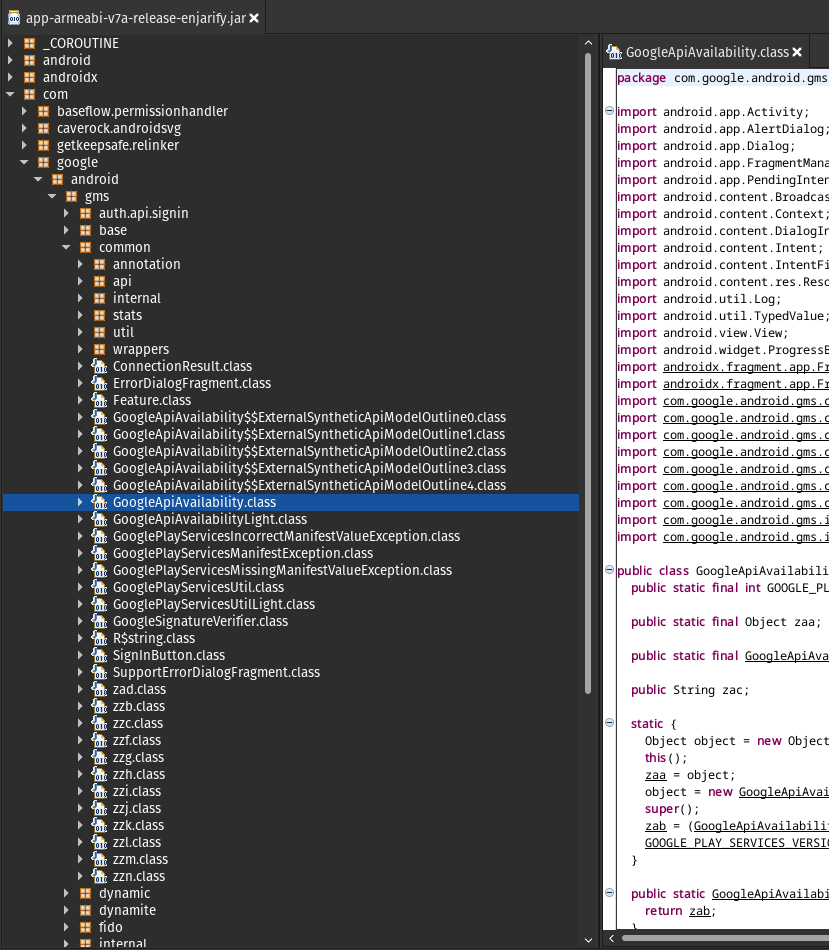
This is not very libre if you’re pulling in Google Play Services:

You’re just using their prebuilt binaries and not compiling from source?

Also wtf:

4 Likes

The F-Droid builds will be ready in a few days I expect. Thanks for letting me know about the resources, I need to check how they can get replaced.

Are you using fennecbuild?

edit: it seems you are:

then why are you having the github release not be the source built version?

Yes, its a slightly modified fennecbuild, the progress is tracked here: New App: eu.weblibre.gecko (!24560) · Merge requests · F-Droid / Data · GitLab

I’m working on getting everything switched to the fennec builds, also the github builds. Will probably set up a maven server, but need to do more research on what will be the best way to not hinder local development and possible contributors.

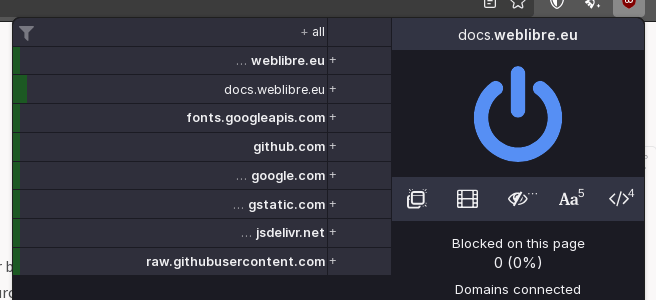
I could already get rid of gstatic from the docs btw, should be already live by now. Rest will thrown out soon.

Edit: Reason for the GitHub builds still relying on mozilla maven is because I’m having quite a vivid release cycle in the alpha phase and in that way builds are ready in usually around half an hour. Building every time the entire mozilla libs is taking a minimum of 4-6 hours with average workers. I need to check what is possible to avoid those rebuilds every time and still comply with f-droid.

In the most recent release this should be more convenient now, as the address is now displayed in a bottom sheet.

The browser is now finally available on F-Droid: WebLibre: Private Browser | F-Droid - Free and Open Source Android App Repository

2 Likes

Hi, I’ve been using the F-Droid build for a few days. The browser surely feels snappier than the IronFox. The UI feels refreshing with other forks look just the same. Here are just a few suggestions:

  • There are few frictions, especially when opening and closing the tabs.
  • The web engine hardening gets turned off every time I close the app.
  • The tab bar doesn’t show on the new tab unless I open a sit.
  • The Bang Categories seems like an amazing feature but there’s not enough clarity on it. It is something that should be worth working upon, and maybe even the something the browser could be marketed at.
  • Some basic settings are still missing that are staple in other browser, like customizing the autocomplete, or the address bar can’t be moved on top.

Overall, this is a great project and already a solid browser to use. If you’re open to it, I’d love to connect and share more structured feedback. I can put together a proper UX audit/journey write-up with ideas that I think could really help this project stand out. Happy to contribute wherever useful.

It appears the settings stick, but the toggle state resets.

Thanks for the feedback! There is currently an issue regarding query parameter stripping that is now controlled when bootstrapping the engine ([bug] complete hardening auto turned off · Issue #27 · FaFre/WebLibre · GitHub) that’s the reason why complete hardening is not showing complete. All other hardening features stay active, you can control that for each setting indicating the closed lock icon. Looking forward to push an update the next few days fixing that.

Input for proper UI/UX is very welcomed! The project is still in an early stage, so much room to get creative. It would be great if you could communicate this in form of GitHub issues like linked above, so everything is consolidated.

I could not reproduce The tab bar doesn’t show on the new tab unless I open a sit.to get it solved some screenshots or videos would help explaining whats happening there. Please also do open an GitHub issue for that, so I can fix it. Thanks.

It’s been a while and the project has been actively developed during the past months! Its worth having a look again, a lot has changed since last August. I updated the first post adding some recent information.

2 Likes

Just downloaded it to check it out on GrapheneOS. Would be even better to have an “Add to Obtanium” link directly on the docs page or your Github directly. I had to manually search, add, and download.

1 Like

If you are gonna take preferences from Phoenix, at least give some credit.

Thanks for pointing that out @any1 . The docs are still in early preview state as I just rewrote them a few days ago. If you find anything else, please let me know (also please feel free to raise a issue directly in GitHub - FaFre/weblibre-docs · GitHub ).

The attribution for the hardenings is now online here: Web Engine Hardening :: WebLibre Browser
I also added Fennec attributions on which base the deps are getting built here: WebLibre Browser Documentation

Added today to play with

1 Like