Does anyone use this protcol here?
Im testing it out, very interesting, however, im not sure how one is supposed to use it with Tor Browser.
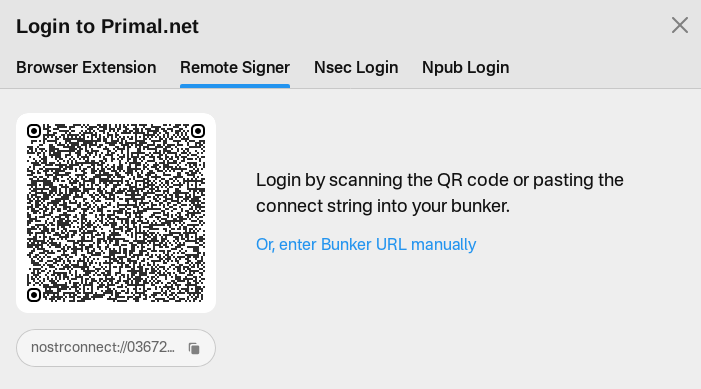
From what im reading, there’s many frontends (not sure how they call this) such as primal.net and others. I created my key in nostr.org where they claim they are generated offline. I saved my nsec and npub, and so I went to log it into primal.net which appears to be a twitter-based layout, and during login, it says to not enter your nsec there as they can read your private key, and to use the following extensions:
“Login using a browser extension like nos2x or Alby”
But it appears those 2 extensions are Chrome-based. Plus if I were to add extensions on Tor Browser it would make it more unique.
There’s apparently another option, using a phone as signer. This also defeats the point as I want to avoid phone use.
So what do you suggest in this context?
TL;DR: How do I log in into nostr sites without no2x or alby if the extensions are Chrome based and im using Tor plus they add uniqueness on the fingerprint when using Tor Browser?
Same question here. About the phone use, it might not be completely a blocker: I think you are referring to a signer like Amber, which is an app that stores the secret key and does the signing for you, but AFAIK this is not phone-specific, there might be dasktop options for this.
I don’t particularly like the bunker idea, the threshold signing is good in theory but prone to footguns in practice, and why does a remote server need to keep a share? I prefer to host my own signer.
But if you add nos2x or any other extension on Tor Browser, you are screwing up the fingerprint, isn’t this a problem for privacy?
Not sure about desktop or what bunker does. Does anyone have a step by step guide on what are you supposed to do? I don’t want to end up using the wrong tool and entering nsec where you shouldn’t. As far as this nak tool im seeing a bunch of commands. All I want is to:
Create an nsec safely locally (apparently. nostr.org does generate nsec locally somehow)
Log in safely on primal.net without showing your nsec and without screwing up with Tor Browser fingerprint and without using anything outside your laptop
Probably not what you want to do. If a bunker runs on your desktop, it connects to a relay to sign notes, revealing your IP. You can run the bunker on a VPS to expose its IP instead, or try running it under a Tor proxy to hide the IP.
What I meant is using a bunker with a desktop client, where the bunker connects to the client over the local network. Gossip client did this well and is worth checking out — it makes some Nostr concepts pretty clear. The desktop client itself also needs a Tor proxy to hide its IP. So do you have to stick with Tor Browser, or can you route other local apps through Tor too?
Step aside: generally Nostr is about censorship resistance and performance more than about privacy, a lot of articles on Nostr stress this. Things like long-term global pubkeys, a public social graph, public IPs by design, and using registered domains for user verification are all there not for privacy. I also don’t know how much common relays tolerate Tor connections.
This is just another statement, but not an explanation why
True, I personally consider my phone more secure than my desktop with npm and all the other dev stuff. The new 2FAS Pass pushes this idea further with a mobile-first (almost mobile-only) password manager, and it makes sense.
Which one do you have? I have a regular Android phone, never got around learning GrapheneOS, no way you can debloat this thing and I don’t feel like buying a Google phone. Kind of ironic you have to use a Google device for any reasonble mobile privacy. Also not in a million years it will be better than a laptop with an open source bios and all wireless hardware disabled to deal with private keys in my book but everyone is free to manage their setup their own way.
Im not sure about that but if you want to manage private keys offline im not sure why you need a phone. You can get an open source BIOS flashed laptop, remove WiFi and bluetooth and anything else you don’t need, and it’s more convenient to use than a phone which you can also lose somewhere because it’s a smaller device.
For online stuff I also prefer amnesic workflows in Tails for anything relevant privacy wise.
I guess one day I will get into GrapheneOS and learn more about it. This setup has been good enough for my tasks, I never got into this whole sandboxing, QubesOS workflow, I don’t really know how it works tbh.