I disagree with iPhones being more private, I heard they collect your data, just not as much as Fecesbook or Goggles. See Hated One’s videos on the iPhone for more info. You do you though, (not related to privacy) I don’t trust such a horrible company that uses slave labour and isn’t the most transparent company out there. And their software is annoying to customise, hence why I have a Framework laptop and riced Linux instead of using M*cOS
Would a faraday bag suffice for this, I wonder?
Since you don’t use ur phone often, I don’t think repaiability would be a reasonable plus for you.
I’d go with GOS + faraday bag.
Edit:
If you’re using your phone for work, I’d especially especially recommend grapheneOS.
more than fine
they do some things right but yeah it is not perfect
PG covers alot of the problems in iOS Overview, I think THO may or may not yave exaggerate some things
but undoubtedly Apple’s security is almost on par
I’ll leave it at that
we wish there was a one size fits all but this is reality rn, so again I personally don’t think either is a bad choice it’s what you value the most
Lastly, repairing is again: optional.
If OP wants a phone to get over mandatory social topics where you can’t do without one, then how does it matter if they can repair:
- their mic
- replace a crack in the glass
- some crack on the camera
People live with shattered phone for months on because phones are quite sturdy when you think about it. They don’t look new and fancy, but they are still functional and can get you if you need a QR code, NFC or whatever the needs are for running some specific app.
Repair is not a silver and holly bullet.
This comes from a guy that sold a Macbook mostly because I didn’t wanted to deal with any potential issue with their screen ribbon borking it all the way.
Still, there are things where a custom made Linux desktop PC is just inferior hence I still bough a Mac Studio. Why? Because it is just more sturdy and less prone to dying because of static or random hardware problems.
Is it repairable? Not really. Does it matter, no because it is not on the move and very few things can happen to it.
Being pragmatic is important sometimes if you have a goal to achieve and don’t want to fight over a thing for 50 hours in troubleshooting/etc. Having an objectively better phone that does the job is better than being heavily political about your purchase.
Never said you said any of that, I’m just mentioning it myself.
Average Joe does not replace a battery, ever. They go and buy a new phone.
If you go with a Fairphone with that goal, you can probably figure out how to be careful enough and not shatter a Pixel because you’re a hobbyist in the first place.
Yes, bumping it slightly. What’s the point of going to 30% privacy bump rather than 99% with a Pixel?
You could say that you can improve any phone’s privacy with enough software, it’s mostly a matter of what you define “enough” while still being usable.
I consider that still having half of the tracking actively running on the phone, is just gaff-tapping an open wound while feeling accomplished of escaping Google’s claws.
I don’t know, you tell us what you need.
I assume from your question that you do care quite a bunch, hence I do suggest a “higher than meh” threshold and recommend a Pixel.
If you’re fine with a subpar solution, then you should probably not even change your current (working?) phone and stick with the gaff-tape approach, forget about Fair/Pixels.
How much hardware in your current house is non repairable (fridge, dishwasher, TV, heating system in the floor)?
Do you want to go and buy a repairable sub-par washing machine just because of politics? Do that enough and you’ll give up entirely.
At some point, you’ll realize that repairing all the stuff around and finding sub-par alternatives is equivalent to a fulltime job.
Depending on your age/responsibilities, you might have enough time. If you’re older, you’ll find out that it’s just not sustainable and that your time is more valuable focusing on other priorities while eating the bullet not DIY’ing your washing machine from scratch after learning about electricity + schematics of such a system.
The friction + needs should align in a realistic way.
Bending the knee to a lot of things in favor of the holly 100% repairability is not the way to go IMO.
It is cool if companies support and behave in that direction, yet you can’t say no to things that are closed-sourced/glued/unfixable because you need to live your life somehow on a daily basis.
Can achieve the same goal yes. 
[…skipping the snarky comment about the famous holly exploding glued batteries part  ]
]
That’s the logical decision yes. But as you can see, this thread is getting quite political and about principles more than practical daily advice.
If you need a device for work primarly, security should indeed be far more important than anything else (like repairability).
Maybe you can also negotiate to have a dedicated device from your employer, if you have high OPsec/critical stuff that you don’t need to leak to the outside world.
off-topic
For the record, Discourse has a proper quote function that allows users to see who you are quoting, not just what text you are quoting. It makes discussions easier to follow. To use it, you can highlight the text you want to quote, as such

Rather than looking like this

it instead looks like this

off-topic
I didn’t see the OP being overly political, so I don’t think my answer needed to be political. It’s to the point.
You guys can use this function…

… to make a new thread if yall want to continue the politics.

again missed this
for people who cannot afford a pixel cough
(recent example)
or people who insist on options like me and perhaps op unless they pick GrapheneOS and one friend I will keep anonymous, this is the their only choice, no ifs, no buts, no counter arguments will be accepted after this.
see my quote where I clarified also:
the parenthesis reffering to above
Honestly having to repeat myself because people dont understand a single thing is already mentally draining, I agree with @kissu OP has all its facts now and we should leave it up to them to decide
If OP asks on which phone to buy, I expect them to have some 350€-ish money to spare.
If you don’t have any of that available, then sure: use the best software available in town.
I would also consider saving a little and pulling the trigger on it when you can.
No rush needed unless your privacy is life-threatening to you.
But I won’t recommend a subpar solution if you’re opening your wallet anyway.
I’ll also stick to just this nice recommendation as a whole, in case OP missed that one.
How have I missed that lmbo. Thanks for the tip
ALSO (since I’ve wanted to update people and I can’t make any more posts for 17 hours  )
)
I’m using my phone for work and personal. I don’t really need it apart from calling and texting others with MS Teams, which I’ll create a second profile for. And personal is calling, texting, maps, tracking items, and music (with Spotify for now) mainly, so yeah.
For the record I want a good tool to do the job. Your points do make sense as I do value repairability, but the difference is with my Framework, I use it all the time, but with the phone I wouldn’t use it often. And yes, while my phone technically works, it doesn’t mean it’s useable. It’s slow and buggy and it’s an iPhone X and I don’t want to be bothered to fix it, because I don’t like Apple (especially since you have to use the locked-down iOS)
Yeah that’s true.
Downside is they’re more breakable, but then I could get a small faraday cage.
I do support your initiative on buying from frame.work, very good company to support.
Their final product is also a good price for an open approach and with a convenient repair-path. 
This is exactly my point, having convenience of it being faster will outweighs repairability any day of the week. Fairphone 4 will not be faster than an iPhone X because you won’t be able to bump the specs of the RAM/CPU.
Repairable doesn’t mean upgradable (unlike Framework’s devices).
Also, having something slow and annoying to use is the perfect situation to be in if you want to limit it to only the necessary tasks + keep it for work only.
I’ve been there too, was extremely happy of leaving my iPhone somewhere and didn’t felt the need to ever touch it if not hella necessary.
I do the same with my current Pixel, long digit unlock mechanism to force myself to go through that friction only when needed. Works very well for me. 
But yes, good luck there with your iPhone, I understand the pain + slugginess of the device.
I guess it depends, this pouch looks quite padded.
I do hope OP is in good faith here, but this does not make me confident:
Yea I’ve been told “OH BUT E OS HAS 2 MUCH HECKIN’ TRACKIN’ STUFF! (insert soyjak face here)”
People seem to really want to convince me to use Graphene, which feels a little biased imo
And apparently the phone will ping cell towers anyway. I can’t think of or find a specific source. That doesn’t mean airplane mode is completely redundant though. Also trackability should be nearly non-existent with a removed battery, no?
Maybe because they care more about repairability or they’re biased or something idk.
But I heard that y’all and PrivacyGuides are “too biased” and you guys “rage and look down on competitors”
Forum hopping, baiting reactions by putting forums against each other, and persistence in face of anti recommendation. Interesting combination for sure. Thanks to @anon12918199 for the heads up.
getting different perspectives from different forums is not necessarily a bad thing. Back when techlore was still a thing I would post in both forums to get both perspectives
this is a decent response too, this is exactly the kind of responses we need to foster
After reading both links (thanks for sharing @anon69871701 btw!  ), I’d say that:
- I find it cool that OP is asking the same question on several places, it is very healthy of a practice to have opinions from several communities, just for any kind of tech review
- I am indeed biased, no problem being open about that for one simple reason

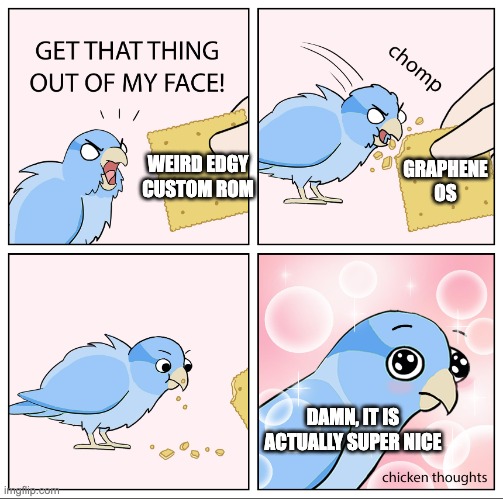
I always avoided custom ROM back in the days (of CyanogenMod etc) because it was kinda weird, difficult to setup and without real big benefits that are well supported, qualitative enough and bring real benefits to the table.
Now that I’ve tried going all in on Apple’s ecosystem, I have to say that GOS is a breath of fresh air.
And Pixels are for quite some time already: amazing pieces of hardware that are refined and very good. Their 9th iteration (starting from the 7th tbh) are just amazing devices all in all from a tech-review only POV.
So the GOS ending on those rather than some Oppo/Xiaomi/whatever is just a super cool coincidence.
- I will stand by
the fairphone is ‘subpar’ on the privacy guidesanytime of the day tho. Just like not having your own favorite VPN or Messaging app being the best of the lot can hurt someone’s feelings, aPixel + GOScombo is just how it is as of today, accept it or quit[1]. - feels cool to see people on Fair’s forum to be honest about their experience/concerns about hardware/firmware/updates
- they do mention
AXP.OSbut given the bleeding-edginess of the project +they only support Android 13I guess there is no point going further- after some quick look into PG’s discussions around iodé, it is also a half-measure firmware not really worth investing a lot of time into
- because it will land somewhere on the range of: Stock ↔ some privacy-focused non-GOS firmware ↔ GOS. It’s OP’s decision to decide on where they want to land while doing a compromise on the repairability benefits
- a person said this on GOS’ forums and I wanted it to happen to 5 months ago, but it didn’t work out, it also made me sad but I made up my mind and pulled the trigger on a Pixel given GOS’ Bluesky confirmation of not being able to land it on Fair’s hardware
-
I too want to support Fairphone’s mission, but I’ll wait for when they’ll have higher security standards to buy one of their devices. I’d be really cool if Fairphone met GrapheneOS’ requirements. Maybe, one day…
- reason was mostly the hardware Titan chip. It is too late for Fair’s team to move towards this direction (they should have thought about it during their R&D process
 ) and they rather reinvent the wheel with their own /eOS/
 - here again, GOS’ Bluesky’s account mostly said the harsh truth of TLDR: “sorry but their security is not on par and we won’t support something that is just inferior”. Harsh but true, deal with it I guess.

- their CEO is open to feedback and criticism regarding the feedback that Linus (from LTT) shared to them, yet I wish he would have considered also collaborating with the GOS team but I guess it’s not in their interest/priorities.
- Just to clear: that situation of lack of collaboration makes me sad but this is what it is
 but it would have been perfect to have GOS run on Fairphone 6.
-
- on GOS’ forums, OP wrote
-
That doesn’t mean airplane mode is completely redundant though. Also trackability should be nearly non-existent with a removed battery, no?
- I’d reply saying that the best of both worlds is still GOS w/ Pixel + faraday bag + no SIM card into the device, kinda like what I do
- one thing forgotten here is: there are other topics where GOS shines and not only on the cell towers, it is hence nice to consider the runtime anti-tracking benefits because OP probably won’t be running their device 24/7 in the faraday bag while powered
-
- I never really bothered checking the iFixIt guides for the Pixel 9a but it is actually not as bad as I thought. Most things are
moderateand the screen (marked asdifficult) is something that one’s should not really be that critical, maybe it’s just me but I never seen somebody loosing entire functionality of their phone with a crack/shattered screen. Today’s phones (especially paired with a cool case) are honestly rock solid if again, you don’t play rugby with them on the weekends.- the battery is also marked as difficult (and if you ask me, looks hardcore af indeed
 ) but that’s also why I go easy on my phone’s usage + limit it to an 80% battery charging limit to extend it to 3+ years
- the battery is also marked as difficult (and if you ask me, looks hardcore af indeed
- I’m glad that a maintainer posted the official post as of why Fairphone is not supported, I was too lazy to find it back

- OP could have cross posted each forums’ (PG + GOS + FP) links to maybe make the communities consider each other’s opinions but I guess that they converge towards the same conclusion anyway.
- OP’s last post is a bit saddening to read indeed to which I’d reply here with:
Does it really matter for the average user like me though?, yes. Don’t drop your phone 24/7, don’t charge it on some fishy 300W cheap charger, and take care of your device as best as you can: it will last you long enough with those healthy habits, that’s all.Also heck even 2 fairphone users recommend I use pixel because the fp6 is subpar, I guess even the FP-pro side agrees on the conclusion- …which kinda proves that people here are opinionated for a reason: Pixel + GOS today is a no-brainer. Take the win and go with it. Or buy a FP4/5/6 and go with some random firmware considering the drawbacks in favor of the repairability, your choice at the end of the day!

- hahahaha, love the
Reparability GuidesorSustainability Guides. I guess OP can always ask on iFixIt’s forums and see their recommendation.
- love the cool link provided by this user that is full of specs and details.

Anyway, writing all of this made me realize something: I guess I am a damn Pixel + GOS fangirl! 
But you know what? I embrace it fully and love it. 
No problem with it: it’s unbloated from any kind of trackers, keeps everything secure, runs fully on FOSS software[2] and is a breath of fresh air all in all.
No problem selling such combo in that kind of situation[3]. 
for once, I am also happy that we do have a single simple go-to way to go, which is quite cool given the usual endless opinionated discussions like VPNs, Browsers, Payment options etc because it gets very annoying and tiresome over a long period to constantly compare etc… ↩︎
because I’m tech-savvy enough I assume ↩︎
guess age made me more pragmatic and care less about fancy Chinese phones manufacturers strong specs in favor of true peace of mind and
don't-come-bother-me-with-your-AI-or-useless-features-nonsensekind of attitude or maybe it’s because some of my older devices just aged very poorly software-wise ↩︎
this isnt corraborated just by ifixit, even jerry who actually made the pixel 10 pro fold’s battery explode can you imagine, couldnt even get it out himself and didnt take the full risk, he also once bended the battery of the trifold but not let it explode which goes to show how far he’s willing to go, not taking the risk for the pixel 9a because of how glue shut it is is damning enough
if you care enough about repairability that you wanna replace it at some point and be careful with it and stick to GrapheneOS, get the pixel 10 (else get the fairphone but not that anyone recommends it and for valid reasons because there is only very few reasons if not rather niche for your needs than a pixel here but it is up to you)
I also value repairability, even in smartphones. I tried to repair my S9 because it was heavily damaged. I replaced the battery, digitizer, even headphone and charging port, but it was a pain to get the adhesive off, and when I could eventually remove the back, I had bits of glass everywhere. This video encapsulates my frustration with repairing smartphones. I used a hair dryer in my case, but even with a heat gun, disassembling the screen was difficult:
On a privacy forum though, maximum privacy would be highly valued because you won’t be repairing your phone all that often (most likely just once). And it’s not really worth repairing smartphones when they will eventually stop receiving support. It looks like Google Pixel 10 is better for repairability, so maybe weigh your options between Fairphone and Pixel 10. If you use a case + screen protector, your phone should last until you need an upgrade, but if you really value repairability that much, then you already know the answer.
I was more concerned about the language used “soyjack”, “biased”, etc. than soliciting information from multiple sources.
Thanks for the great write up along with that 