I’m currently testing: GitHub - bikram-agarwal/ObtainX: Get Android app updates straight from the source. And install it any way you want. · GitHub
No issues so far.
Not sure why this would disqualify Obtanium but it’s an upstream issue:
Obtainium 1.7.2 switched to using the cronet_http package to make requests. This is because it allows us to use Android’s built in certificate store instead of a separate list built into Flutter. This way, users can add/remove certs in Android, and Obtainium will act accordingly.
But Cronet’s request callback uses package:jni in Dart, which GrapheneOS denies (the RESTRICT_MEMORY_DCL flag in your log). This is an upstream issue tracked in flutter/flutter#191385 and dart-lang/sdk#64137.
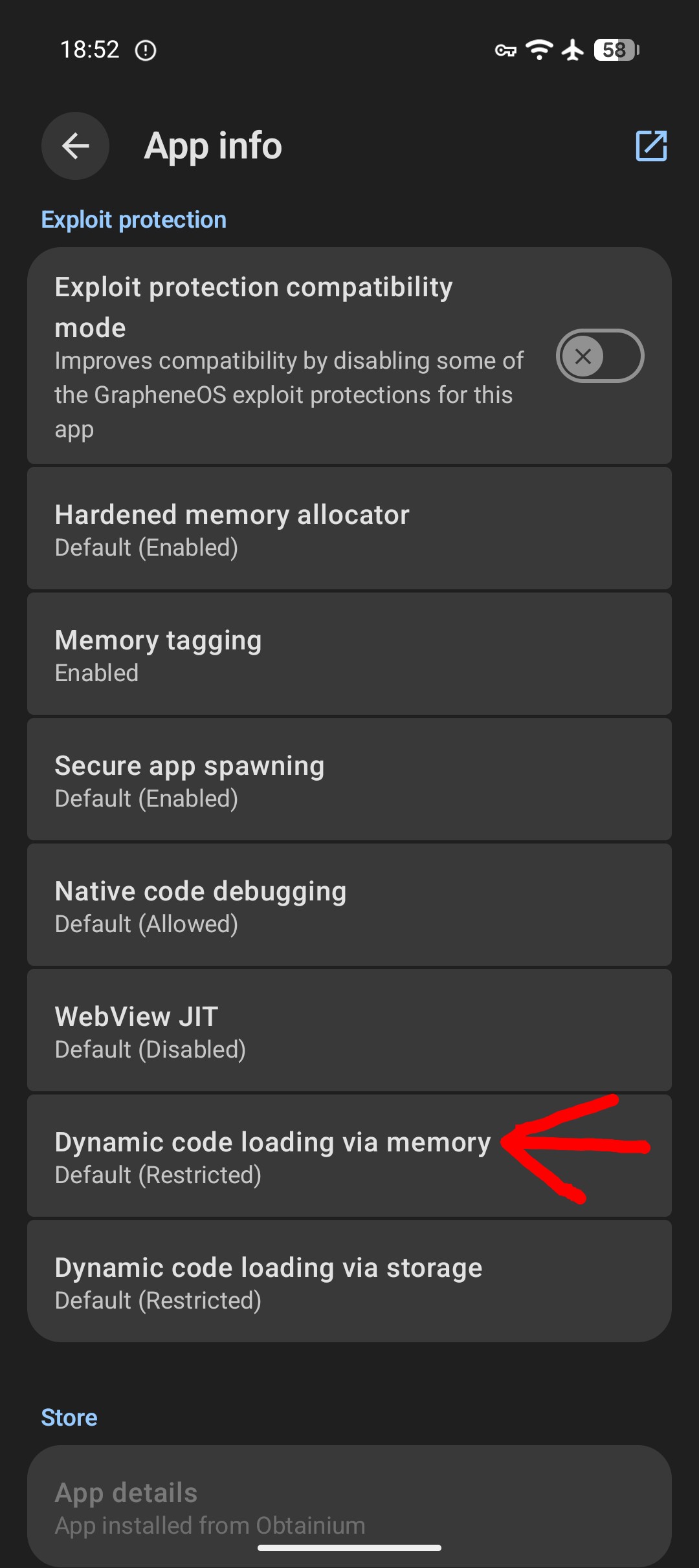
In the meantime, you can work around it: Settings → Apps → Obtainium → Exploit protection → Dynamic code loading via memory → allow.
Because it’s an obvious security downgrade, especially for an app that installs and updates other apps.
Allowing DCL via memory means Obtainium can execute code generated at runtime, which isn’t covered by signature verification. It also removes an exploit mitigation that makes certain memory corruption vulnerabilities harder to exploit. Whether the issue originates upstream or not doesn’t really matter.
I’m using Obtainium 1.7.2 on GOS and it’s running fine without changing any security settings.
Try checking for updates.
Also working fine.
DCL via memory restriction is an exploit protection not enabled by default in GOS.
Tested it and I’m getting a warning triangle at several apps now.
The warning says something like:
- “This app config may prevent updates”
Some off the apps with this warning are now automatically archived in obtainium, but not accordingly to the configuration settings. Even the most recent versions of Proton mail, Tuta, Brave.
This is something else. You are probably talking about the “Update Health” section which was introduced in 1.7.0 to flag possibly stale app configs.
The issue described in the discussion here is this: In GrapheneoOS app settings you can restrict DCL via memory. It is an exploit protection that is disabled by default - you have to activate manually. Obtainium version 1.7.1 or lower worked with this restriction as no DCL was performed. Now, in version 1.7.2, Obtainium crashes on start and you get a notification from GrapheneOS telling you that Obtainium tried to perform DCL via memory.

Thanks for this clarification, I messed up two things.
Ente Auth and Ente Photos also require DCL via memory too. My browsers and Grayjay also require it as well as sandboxed play services.
Hopefully this resolves itself on its own quickly through an upstream update. But if Privacy Guides were to stop recommending Obtainium over this, they’d have to make big changes to other mobile app recommendations under the same rule.
And if a feature like this is considered a requirement, it would also destroy desktop recommendations.
I’m getting it on Brave, and SimpleLogin.
Has anyone else noticed that The SimpleLogin app hasn’t been updated since July 2024?
So should we change it to restricted? Any side effects?
I am no security expert, but in my understanding this GOS feature is a mitigation mostly against local/remote code execution vulnerabilities. So it is best to set it to ‘restricted’ by default. The only downside is that most apps that perform DCL via memory will often crash when its set to restricted. This is probably the only reason why its not set to restricted by default in the first place. However, in these cases you get a notification (as shown in the screenshots from my reply above) and you can manually unrestrict the individual app if you need to.
More details on DCL
DCL is discouraged in the official Android developer documentation.
A paper from 2014 showed how DCL might be used by malware to evade offline analysis systems.
AI-generated definition:
Dynamic Code Loading (DCL) allows apps to:
- Load executable code that wasn’t shipped with the initial APK
- Execute code from memory-mapped files at runtime
- Download additional code modules after installation
There is a 2.0 version that has been in beta for a long time but it works good.
The developer of Obtainium posted a new reply to this issue on the question if this change will be reverted:
Since Obtainium is written in Flutter, it does not by default respect the full certificate store on Android (the certs used for HTTPS requests). It seems to only respect the OS cert list but does not detect certs the user has manually added or removed. Obtainium has had to work around this in the past doing things like baking in certs for specific sites. The right way to do it would be to just respect Android’s certificate store properly, and that’s what a new package we’re now using let’s us do.
I didn’t come across the DCL issue before release because DCL permissions are allowed by GrapheneOS by default (and for that reason I don’t think most users will encounter this either).
I think it’s worth keeping because managing HTTPS certificates in Obtainium adds a lot complexity and shouldn’t really be in scope (this is different from the pinning feature which does something that the OS by itself can’t). The OS should be responsible for these things in the first place, not individual apps (it’s also unexpected behavior. If a user adds a certificate to their OS, they would expect all apps to respect it). The minority of users who are on GrapheneOS and have the DCL permission turned off can always just turn back on for Obtainium.
So while I think we will keep this new package going forward, I think it should be reasonable to add a toggle that lets you switch back to the original Flutter HTTP library, and then you won’t see this error. (…)
I think DLC via memory is set to restricted (default), it’s DLC via storage set to allowed (default) in GOS.
Mine are both set to allowed by default - pretty sure I never changed them - as stated by Imran on the issue raised - "Obtainium tried to perform DCL via memory" after the latest update · Issue #3442 · ImranR98/Obtainium · GitHub
This post has made me reconsider how I set it up though.
Good to know.
That would be a good compromise.