I guess if you’re blocking all the telemetry at the network level it’s got to be quite good? Though I seem to recall a controversy where Apple was using it’s privileged access to skirt around that for first party trackers.
1 Like
Network-level blocking is good, but Big Sur changed the model: NKEs were deprecated and firewalls moved to Network Extension. Apple controls that filtering path, and some first-party traffic can bypass third-party filters. That means LuLu/Little Snitch aren’t a guaranteed “zero Apple telemetry” barrier.
3 Likes
macOS got intentional backdoors that allow remote root privileges, wipes and deletion of applications.
Using a DNS based blocker (NextDNS/ControlD) could be an alternative then? I think Apple only has one telemetry domain, and IMO they don’t collect that much telemetry (and even less that is tied to your account/device), but of course that is still much more than Linux (zero, unless enabled)
Any source? I would think that they don’t create advanced security features like “Memory Integrity Enforcement” just to implement backdoors that anybody could find.
Read the whole page. There are more backdoors that are suspected to be intentional
“Anybody could find”. That can be 5 to 15 years and after it’s found they will say it is not intentional
1 Like
Seeing as the first “back door” in that list is Apple updating malware signatures in their antivirus to include a specific binary I don’t think that list is helping your argument.
3 Likes
Apple basically releases hundreds of “backdoors” every month lol.
This kind of suspicion could apply to virtually any software. Sure the possibility exists.
For Apple, if they really had backdoors, why wouldn’t they simply provide them to the FBI, Cellebrite, or other law-enforcement and forensic agencies?
Yeah they work closely with the NSA, do they not?
Any proofs
I think the evidence is that apple uses telemetry to provide services. They will “backdoor” if they think they can improve the experience or security for their average user. Their average user is not the average person on this forum. There’s nothing sinister or deceptive going on, but it’s never going to be as private as Fedora, where they would not even attempt to provide these types of services.
If you don’t trust the OS, the only solution is not to run it. If you do trust it, Little Snitch may provide some additional benefit by blocking some unneeded services, but isn’t strictly required.
Using open source applications on macos can go a long way since, as far as I know, Apple is not harvesting data from inside third party applications. No sign in macos can be a good solution for some use cases.
1 Like
It’s a quote from Whonix and I agree with them and GNU. Host Operating System Selection - Whonix
Backdoors are not there for law enforcement agencies like FBI. Do the FBI have access to Intel-ME and AMD-PSP backdoors? The NSA has access to every computer with AMD or intel CPU
They cite the FSF article as their proof…


This is just them repeating the first article so it doesn’t provide additional support for your claims.
They don’t
They do not cite them if they do not agree
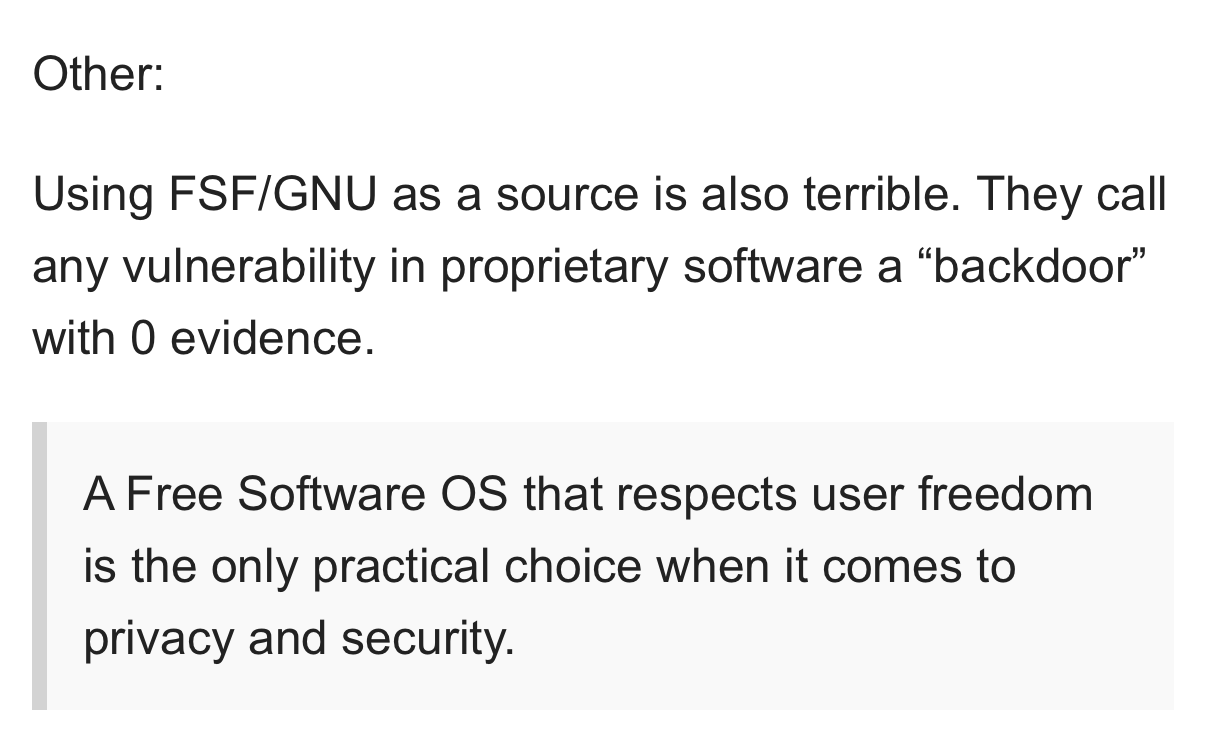
I do not agree with every claim of GNU and I can see why it is not a good source for the Whonix wiki. I do think a silent update without user authorization is a backdoor. Some experts agree and some disagree. Apple can use it to do targeted malicious updates.
Madaidan disagree with this definition. Patrick agrees. Both agree that this update mechanism is not secure
This is quite questionable. For example, biometrics are optional, automatic uploads are never enabled without an icloud account, apple has never deleted anything I downloaded from a competitor*, and no applications like haveno (cryptocurrency) have ever been censored or prevented from running.
MacOS falls into the “not private” spectrum of OS’s, but assertions about its current state beyond that are fear mongering.
*macOS has suggested it in the case it can’t verify the safety of the application with gatekeeper. I must click “move to trash” for it to be put in trash and then empty the trash to delete it. Note there’s no correlation between this and it being an application competing with a default macOS application. Non-competing, gatekeeper failing applications get identical treatment.