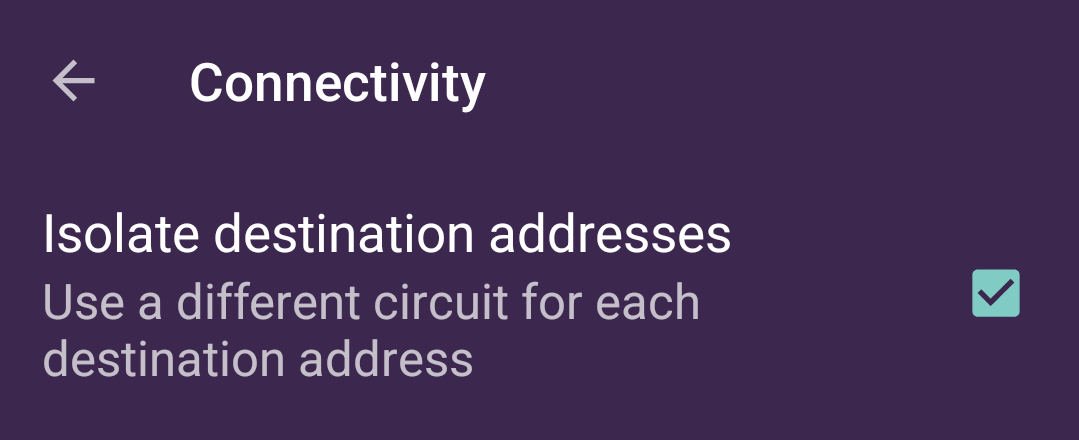
The Tor Browser and also the Tor VPN (referring to Orbot) are using a different exit node for each destination address you connect to (in Orbot you need to activate this).
Since Orbot is technically just a VPN, I wonder if it would be possible for normal VPNs and/or Multi-Party Relays/mixnet VPNs like Obscura and Nym to use a different exit server per address?
Orbot is technically working like a VPN, its literally using the VPN API of Android.
But nonetheless this topic is not about whether Orbot is good or not but about a specific feature of Orbot and Tor in general and whether it could be implemented in commercial VPNs
This feature is to chose different exit nodes for each destination address:
This is better handled client side, controlled by the user. Two examples, firefox containers let you use separate vpns for different containers. Qubes-os lets you use different vpns or networks for different vms. You could also do this with kvm, virtualbox, etc. If your plan allows, this could include different instances of the same vpn so the end points are different.
Yes, this is possible for “normal” VPN apps to do. It is tricky to get right since some of the popular services generally do not like clients with “roaming IPs”.
Rethink, a WireGuard client for Android that I co-mantain, can route connections through multiple WireGuard tunnels (as if it were load balancing among those tunnels).
Multi-Party is also fully implementable on the client (we implemented this ~Sep 2024 for Rethink at the urging of GrapheneOS developers/community). MPRs don’t need any sophisticated server side infrastructure. Or rather, aren’t special in any sense, unlike MixNets.
The VPN would use the same IP for the same destination address, so the service should not have a problem with it.
Then use another IP for a different destination address.
You’d expect this is as simple, but a single service can be behind different IPs. Of course, the vice versa is also true: Different services behind the same IP.
I dont say its simple, but its definitely possible, otherwise Tor Browser and Orbot VPN would not be able to implement it.
And there code is public, so any VPN developer could use it as an example
Mihomo can do that. Here its documentation giving some example. Its so powerful, the rules can be used to segregate to separate wireguard, vless, vmess, shadowsocks, socks endpoint depends on domain, subdomain, asn, network, package name, userid rule etc. Can even be used as firewall. You can do fancy stuff there like route cloudflare captcha to cloudflare warp wireguard to lessen the captcha looping etc. On android can use Clash Meta or Flclash, on ios can use Clash Mi.
Theres also sing-box with its documentation here but its more complicated than mihomo. Sing-box even got tailscale routing so as example can create rule to route immich app to dedicated tailscale endpoint etc.