With the latest version of ProtonVPN I found it has China but I does not see China in the list at VPN server list: Secure Proton VPN servers in 140+ countries | Proton VPN
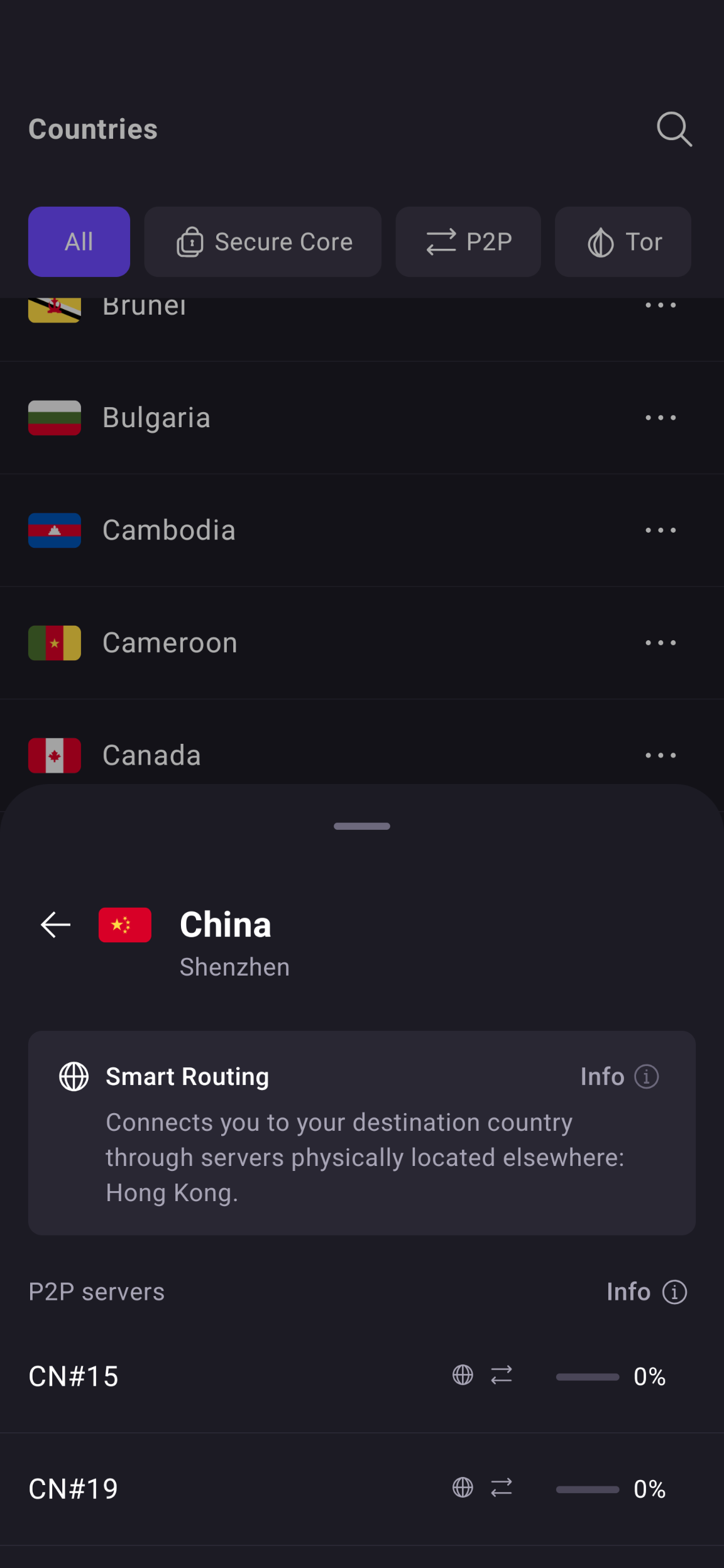
In the list of countries from the link you provided:
Hong Kong SAR China
I got it. Thank you for your support.
Sorry, @seize ,
I just checked again. It seems that is Hong Kong when I expend the city but the screenshot is Shenzhen. It looks like ProtonVPN who does not update the website.
Do you know what’s the difference between Hong Kong and China?
I suppose I should have included this with my original reply, my bad.
The screenshot you provided already explains that the Shenzhen China server is using “Smart Routing”, and that the server in question is physically located in Hong Kong.
It does appear that the location list is outdated now, not including an entry for Shenzhen China, it took a second read through for me to fully realize the link in the original post is a list of both physical and virtual/“Smart Routing” locations where Proton VPN has servers.
Wow. ProtonVPN increases too fast with many servers and many countries.
Not really. The “148 countries” claim is misleading. Most of those are “Smart Routing”, their name for virtual locations where the actual server is somewhere else. They have physical servers in roughly 40-62 countries.
Here, they do use a Chinese server from what I understand.
It’s actually quite nice an addition. Bear in mind you don’t get the censorship, but you can see how websites look inside China. For example, you can see Chinese Bing (censored version of Bing). This will be big for researchers. I wouldn’t bet on it lasting though.
Proton VPN offers a “Smart Routing” server connection for China currently, but no physical Proton VPN server is located in Shenzhen, and instead the traffic is being routed through Hong Kong.
My previous reply might do a slightly better job of explaining this.
They must get some IP address from a Chinese server. In fact the server displayed is in Guangzhou.
It seems Shenzhen China has been added to the overall server list now.
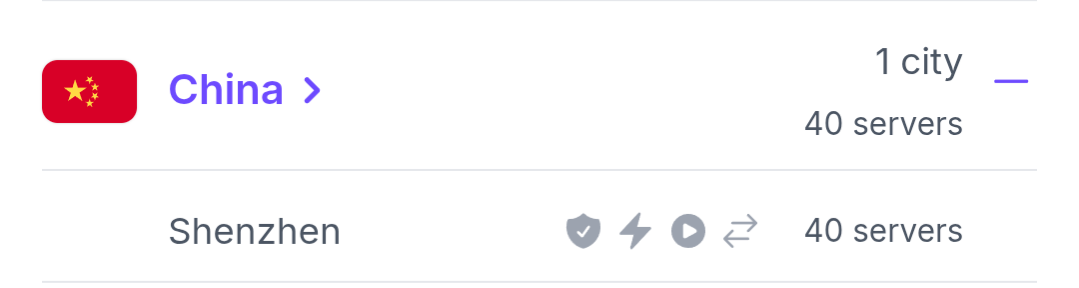
As discussed previously Shenzhen China is a location being server by “Smart Routing” from Hong Kong.
As to @Encounter5729 's point. @Proton_Team may be better equipped to answer this, however it was my understanding that you do not strictly need a server physically located inside China for a VPN to assign you a Chinese IP address.
See also: Stream the best of China with a Chinese IP address | Proton VPN
Okay, I looked and yes, they don’t need a server inside China proper. But the technique is quite weak, and any websites that has a database that has other sources than official records will see it.
I am an avid ProtonVPN user for many years (Paid plan).
Currently I am traveling around China, and the new China server caught my attention. Now few days in since the option appeared, ProtonVPN totally stopped connecting from mainland. No single location works. It happened last night around 5PM China time.
No single country works, it just does not connect at all. Wondered if anyone else noticed it.
Call me paranoid, but it feels like PCR has put Proton on their radar and now it’s kaput.
Which protocol are you using to connect to the vpn?
GFW blocks VPN and proxies, and they are extremely good at it.
The wall CAN detect and block ProtonVPN, even in its stealth mode.
ProtonVPN and Tor Webtunnel did not consider advanced encrypted traffic analysis in their design, but the Chinese GFW has been performing ETA to detect proxies for a decade. There is another TLS-based proxy protocol called Trojan that did not mitigate this, and it was detected and blocked in China ever since 2022.
See https://www.usenix.org/conference/usenixsecurity24/presentation/xue-fingerprinting for a basic idea of how this is possible. To put it simple, the inner TLS handshake reflects in a fingerprint even with the encryption of the outer TLS, because you cannot hide the very stable signal of packet size, direction and timing with encryption.
And there are a million other fingerprints that make much more sense than this TLS-over-TLS fingerprint. For example, the libraries that mimic the browser TLS fingerprint (like JA4) are doing a terrible job. They are just barely enough to fool the GFW so far.
There are quite some protocols that mitigate TLS-over-TLS: the ones that work in China. You can arguably say they are the hardest to detect (though far from perfect). For example, vless-xtls-vision and vless-xhttp. They use padding and mutiplex, which are explained in the paper above.
They are both implemented in:
The docs are on
These stuff are extremely complex, and to achieve the highest level of anonymity (in terms of hard to detect) you need professional knowledge. You can find paid services that deploy these kind of proxies, Chinese students and programmers use them everyday. But from a security and privacy point of view you definitely don’t want to buy them.
Xray project does offer a beginners’ guide of deploying vless-xtls-vision on your own server. It is not their best protocol but still works for now.
If you have some experience with Chinese GFW you know all the VPNs recommended here are doing a bad job in being undetectable. They are not prepaired for such a threat model.
If you go to China, perhaps you can try to get a traditional VPN from educational institutions or global companies. They are very easy to detect, but are specially allowlisted by the wall and will never get blocked. BTW Cloudflare warp seems to be permitted currently.
From what I heard, the easiest for foreigners visiting China to circumvent GFW blocks is to use a foreign eSIM (with a phone bought outside of China). You can then create a hotspot from your phone to use it with your laptop.
I confirm it is true. You can use eSIM roaming freely in China.